Is this Impact?

I strive to make a positive impact through my work, as many academics do. I also support colleagues to develop their own impact and am often asked by organisations to comment on their plans for creating change.
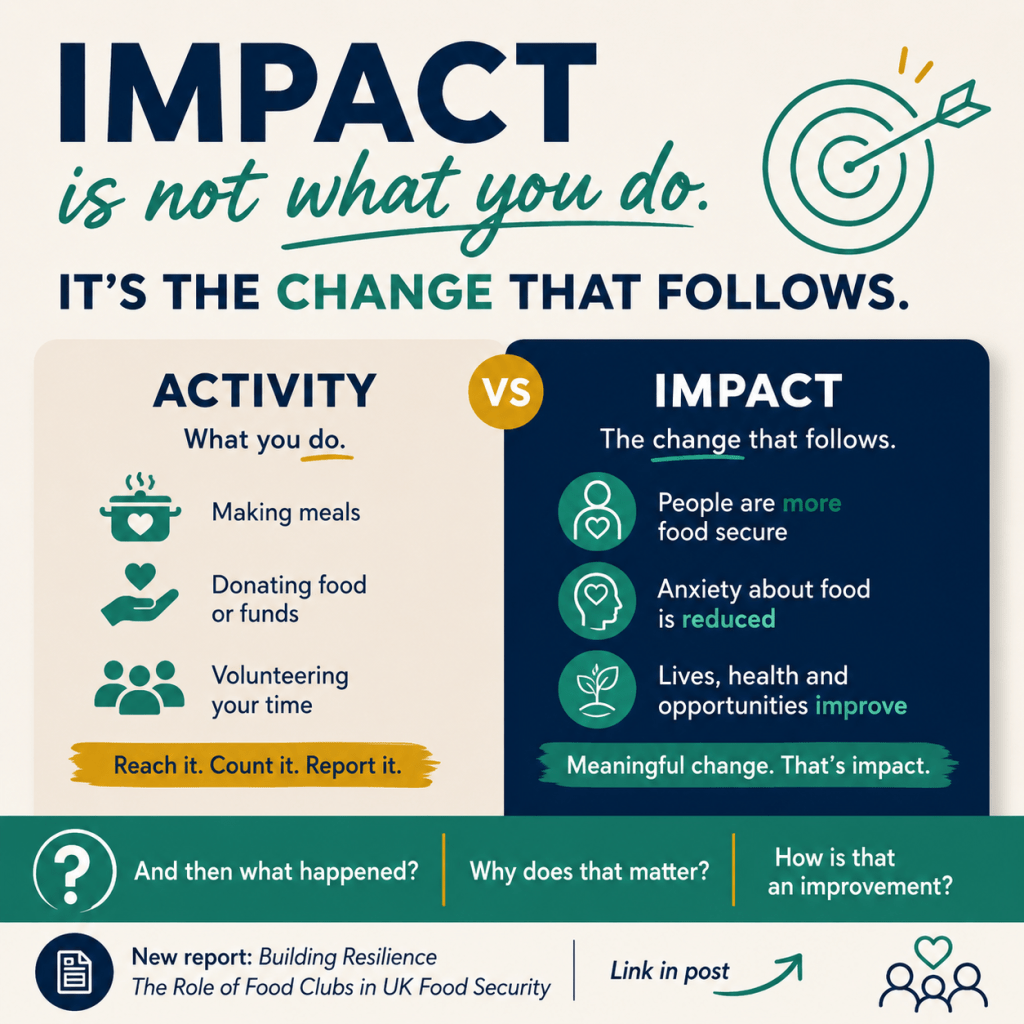
Graphic of the difference between activity and impact.

So often people think #Impact is what they did—making meals, donating #food or funds, volunteering. They then measure the significance of that activity in terms of its reach: millions of meals served, pounds donated, or volunteer hours.

But that’s not impact.

That’s activity.

The real questions are:

➡️ And then what happened?
➡️ Why does that matter?
➡️ How is the world better because of it?

If the answers to those questions are not compelling, then it may be time to rethink what you’re doing—and how you’re doing it.

This is why, in our recent report on food clubs, we didn’t just ask how many people attended or how much food was distributed. We asked whether food clubs helped people become more food secure, whether they improved diets, reduced anxiety about food, strengthened cooking confidence, and reduced reliance on emergency food support.

Those are the outcomes that matter because they tell us something about whether people’s lives are actually improving.

Measuring activity is important. But measuring impact means asking whether that activity has created meaningful change for the people and communities it was intended to benefit.

I’d be interested to hear: What’s the best example you’ve seen of an organisation moving beyond measuring activity to demonstrating real impact?

Food Deserts. You and yours Radio 4 interview

I was interviewed on BBC Radio 4 today for the you and yours show. This very quick interview starts at about minute 29 and you can listen to it directly from the i-player here: https://www.bbc.co.uk/programmes/m001153x

They sent me four questions before hand:

  1. What are food deserts?
  2. What impact do they have on communities?
  3. We don’t cook at home, is this the problem?
  4. If we changed our understanding would this address the issue?

The interview was short. If I had had just a little more time, this is what I would have said:

Food Deserts and Unjust Foodscapes

This blog post draws from a forthcoming chapter I have written for The Routledge Handbook of Landscape and Food that is edited by Josh Zeunert and Tim Waterman.  The book will be published early in 2018.  I am drawing on a section that focuses on the food desert concept in order to show how the standard interventions aiming to address food deserts does little to reconfigure the institutional forces that give rise to unjust foodscapes in the first instance.  The excerpt closes by identifying some of the ways that food justice activists are tyring to address the problems.  The full chapter is available here to download.  Continue reading

Building an Unjust Foodscape: Shifting Governance Regimes, Urban Place Making and the Making of Chinese Food as Ordinary in Hong Kong

This is the text from my recently published peer-reviewed paper in the journal Local Environment.  The paper will be part of a special issue on Food Justice edited by Agatha Herman and Mike Goodwin in the future. The e-paper is available, but behind a paywall until May 2018. I am making the text available here as per the copyright agreement, but for correct referencing please see:  http://www.tandfonline.com/doi/full/10.1080/13549839.2017.1328674

DOI: 10.1080/13549839.2017.1328674

Megan Blake ORCID http://orcid.org/0000-0002-8487-8202 Continue reading