Ultra processed foods are in the news more and more. A recent meta-study found there are a myriad of health issues linked to diets comprised primarily of such foods. When thinking about the level of processing, foods are typically categorised into 4 groups: unprocessed or minimally processed, processed culinary ingredients, processed foods and ultra-processed foods.
Processing is not a bad thing in and of itself. Pickling, fermenting, canning, even chopping and cooking are processes. We process things to turn them into food at home, in restaurants and in factories. Ultra-processed foods are distinctive in that they change the nature of the original ingredients, such that very little of the original whole food is left, and they include chemicals that you would not find in an ordinary kitchen. These include emulsifiers, artificial colours and flavours, stabilisers, sweeteners, and other additives to make them taste better and last longer. They also are fatty, salty or sugary and lack dietary fibre. What we might think of as empty calories.
Ultra-processed foods are also less expensive and, because they last longer than fresh foods, are less risky for a tight household budget. But we pay for this low cost in other ways. Individually, we pay for this food with our health. We also pay collectively, if somewhat unevenly, for it with the environment. Ultra-processed foods drive mono-crop production that undermines ecosystems and harms biodiversity. The processing is also energy-intensive and dependent upon petrochemical inputs, thereby contributing to climate change.
We can tell people to stop eating these foods, but educational campaigns won’t work on their own. People need to have the capability to eat differently. If those foods that are better for you are not available in the place where you live or they are too expensive then all that the education will do is create further feelings of guilt.
Ultra-processed foods are a key part of a system that rewards producers for creating these foods in the form of profits now, whilst undermining our global food security now and into the future. Because this is a systemic problem we need systems solutions that intersect at all points of the supply chain and operate at different scales. Introducing disincentives for the production and sale of ultra-processed foods, shifting to agroecologiecal farming practices, and re-introducing these better foods into neighbourhoods all need to be considered.
I recently participated in a webinar by Healthy Diets Healthy Life (HDHL) as part of the European Commission’s Bioeconomy Changemakers festival. In addition to learning about HDHL and hearing two other speakers talk about ultra-processed foods from a bio-economy and a nutrition perspective, I talk about the contexts within which people access and purchase food. My section starts at about 38 minutes in.
webinar on ultra-processed food
So what can we do right now? We can pressure government to put constraints on the way those in the food sector operate and provide incentives to act in a way that is better for both health and the environment. Individually, we can also try where we can to introduce more foods into our diets that replace the ultra-processed foods we currently eat. As a society, including commercial organisations, we can also support initiatives that help people by expanding their access to and knowledge of those foods that are better for them, which do so in non-stigmatising ways. I talk about two such initiatives in the video.
I am frequently asked to explain what a food desert is. I thought I would make this short video to provide an understanding of how I approach the issue of food deserts. I have written more about them inthis post about a report I was involved in, and this post is an extract from an Encyclopedia chapter that I wrote concerning food justice and foodscapes.
A short video about food deserts and how they come about from a consumption perspective.
People make rational choices within the constraints of their choice sets. Choice sets are constrained by the resources they have at their disposal, such as skill, time, mental and physical health, and money. These choice sets are also constrained by the physical and social conditions of the place in which they live, broader institutional contexts and their own social positionalities.
When there is a concentration of people making similar decisions based on similar circumstances, demand for an item, such as healthy food, decreases.
At the same time, food retail operates within a system where profit-making is the main priority. When an item ceases to have sufficient demand to maintain its profitable status, it is usually dropped from the range of products offered. Shops close when the ability to profit at the store level is insufficient compared to other store locations.
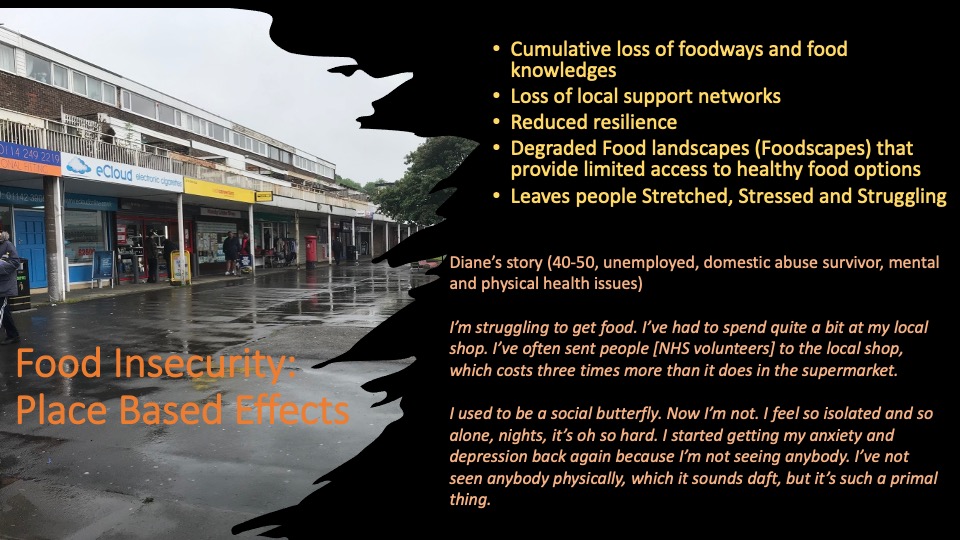
Slide demonstrating the effects of living in a food desert
What happens is that places become hollowed out, and foodscapes are degraded. For those who live in these places, the struggle to manage increases. When people are facing a struggle, their physical health suffers, but so does their mental health.
There is much a supermarket can do to support people to access the food they need. For example, be willing to take a loss on some food items because they are important, keep a location open and provide low-cost but healthy food items because that is what people need and consider not the profitability of a single store or product line. This might involve asking what level of growth or profit is enough? Importantly, supermarkets have recently made decisions to limit their profits due to the cost of living crisis, so there is room for manoeuvre in this space.
Source: This is money. 7 May 2023
But this is not something we should just leave to the supermarkets. For a transformed food system, we also need to generate diverse foodscapes. This means providing multiple avenues for accessing food that extends beyond and reduces our dependence upon supermarkets.
I collaborated The Bread and Butter Thing and The Food Foundation on a survey with households with who have children in year three and above who do not receive free school meals. Respondents are parents who are members of TBBT food club. The results show that children are missing out on lunch because they fall through the cracks in Free School Meals provision or their parents are just above the (extremely) low earnings threshold. What is more, the number of parents within this group who are missing out on meals is even higher. The results are below.
Households where at least one child is in year 3+ and is not registered for free school meals.
Households with a child in year 3 or above not registered for FSM (n=734)
Yes
No, but worried
Either skipping or worried
I would like my child to have FSM
Child goes without lunch at school some days
15.5%
42%
57.5%
Child eats a smaller lunch at school some days
31.5%
30.6%
62.1%
Child eats a less healthy lunch at school some days
30.5%
21.9%
52.4%
Children are having to go without food or eat smaller meals because they can’t access free school meals
Household with a child in year 3 or above not registered for FSM
Yes
Parent struggles to feed children at the weekend (n=734)
36.9%
Parent skips at the weekend to make sure children have food (n=734)
62.5%
I would like my child/children to receive FSM (n=529)
85.3%
Parents are doing their best to feed their families but go without food.
Comments from parents who say they are skipping meals include:
My child is home-schooling at the moment, and yes, we do skip some meals daily due to being short on food, but unfortunately, your child has to be in school to receive free school meals I’m working to get him back I to school but will be a bit of a wait due to him having some problems that need diagnosed so he can receive help he needs in school.
I have 5 children and my husband lost his job in Feb 2023. We have been unable to access Universal Credits as the system is too complicated as I cannot attend all the appointments because I am self-employed childminder and always have children with me. TBBT had been a lifesaver in helping me to provide healthy food for the children but by Monday packed lunches are bare minimum of whatever I can find leftover for them. Some of my children are on school meals as they prefer this and they are always paid as I prioritise food for them they don’t have many luxuries other children have but TBBT has helped me ensure they have a good diet. I have been able to make huge panfuls of vegetable soup with the quantity of vegetables and banana bread which had become a staple in our home but free school meals would be such a blessing. I often skip meals if there isn’t enough of one meal or I’m bogged down with work and juggling everything to make sure the children have their needs met.
The threshold for getting free school meals is so low that even though I do not have much money after bills, I don’t qualify. I am on a low wage due to disability and struggle to make ends meet a lot of months.
I am just over the income threshold so don’t qualify for free school meals. This is financially difficult as when you work, there is very little help. I am so grateful to the bread and butter thing as this makes all the difference. My kids would never go without food as I would never allow that to happen but it would be such a help to receive free school hot meals. Usually, we do 2 days pack lunch and the rest we pay for hot dinners, this keeps the cost down a little.
Because I claim legacy benefits, I’m not entitled to free school meals even though my income, according to universal credit, would qualify me. No matter how much I plead with the council, they don’t help.
I work part-time and receive universal credit top-up. I wish my child was eligible for free school meals. I make sure she has fresh fruit and a sandwich every day, but I can’t afford much else.
Because I receive working tax credit, I do not get any help with rent or meals. It would be better not to receive it (working tax credit) because it’s costing over £100 a week for school dinners for my 2 teenagers.
Both parents work, although one is a part-time worker, to avoid nursery costs. We don’t receive any benefits as over the wage limit but pay a mortgage, 1 car which is needed for work, and every other household bill we pay. All bills are covered, so no debts but little left from 2 wages for food.
Who gets Free School Meals?
All children in key stage 1 (reception, year 1 or year 2) in England who attend school (e.g. are not home-schooled) receive free school meals (FSM) regardless of household income. Those in year 3 or above do not automatically receive free school meals; instead, they must qualify and register to receive them. Children who are home-schooled also do not receive them. Qualification is based on household income, benefits receipt, and registration in a government-funded school. For those on Universal Credit who have applied for FSM after April 2018, the household income must be less than £7,400 a year (after tax and not including any benefits received). If the household income increases above the threshold in the future, but the household income still includes some Universal Credit contribution, children remain eligible until they move to the next phase of education (e.g. from primary to secondary school). Before 2018, there was not an income threshold for Universal Credit claimants. Importantly, having a sibling receive free school meals does not automatically qualify a second child’s (often younger) eligibility.
A claim for FSM is made through local authorities and is typically instigated by parents. However, some local authorities, such as Sheffield, have introduced automatic enrolment[1]. Furthermore, the national food strategy recommendations call for automatic enrolment in FSM. In March 2023, Harriet Harman asked the Secretary of State for Education (Nick Gibb) what discussions the DoE has had with the Department for Work and Pensions on introducing automatic enrolment for free school meals to eligible children. The secretary of state responded that there are no formal assessments concerning the number of pupils that would become eligible for FSM through automatic enrolment and no plans for automatic enrolment. He did indicate that FSM take-up was estimated to be 89% according to benefits data[2].
The Bread and Butter Thing (TBBT) is an affordable food club. It is not a food bank. It works with volunteers from 115 local community organisations across 23 local authorities located in the North of England to provide low cost, healthy food to people who are not in food crisis but are vulnerable to it. These are people who may be skipping meals or who are just about making ends meet. They may be struggling and stretched, but usually not destitute. Alongside the food, TBBT works with other organisations to help build people’s capability to live their best life by reducing barriers and improving their access to and utilisation of the resources they need. Unlike food banks, the food is not free, and the local volunteers come from the community of people who use the services.
According to the Food Standards Agency Food and You 2 survey (wave 6) conducted in the autumn of 2022, the number of people who use food clubs, sometimes also known as a food pantry or social supermarket in the UK, is larger than the number who use foodbanks. In England, about 4.8% of the total adult population, or about 2.23 million adults, used a pantry or food club between Autumn 2021 and Autumn 2022 (compared to 4.6% or 2.14 million foodbank users). These services operate in all regions of the UK. The largest single provider of such services is TBBT. In addition, there are at least 100 franchise branches within the Your Local Pantry network started by Stockport Homes and Church Action for Poverty, and Feeding Britain identifies 348 affordable food clubs within their network (although it is unclear what overlap there may be tween Feeding Britain and Your Local Pantry). It is likely that there are additional food clubs operating independently of these organisations. However, there is no clear data available for finding them. Only TBBT can directly communicate with service members because they work in partnership with local organisations rather than the franchise model used by other networks.
Despite the uptake of these services, relatively little is known about those who use them. The analysis presented is based on data from a survey conducted by TBBT, which has a membership of more than 72,000 households using their service. Survey details are as follows.
Total who opened survey text= 21,886
Total who answered survey =2917
Total who responded with a child or children in year 3 or above = 2671
I give a lot of talks and interviews about food security. Last week I gave 2; the week before, I gave one; and at the beginning of January, I gave another. I am grateful that people what to hear what I have to say and that it is, hopefully, helping in the fight to get people to listen to the issues that people are facing around food security.
Food insecurity exists in wealthy economies where there is enough food to feed everyone, but it is not available to everyone. Food insecurity is not just something that people somewhere else experience, be they in war-torn or poor countries or places where there has been a disaster. I am not trying to diminish the experience and trouble people in these “other” places face. Indeed, their trouble is awful.
But food insecurity is experienced in bellies and in minds and in bodies. It is personal. Food Security becomes geographical when multiple people from the same place are similarly impacted.
Saying that support should go to the “most needy” creates an insidious competition. To get help, you have to prove you fit into this category. Many people don’t see themselves that way–there are always others we can point to who are worse off. Many don’t want to participate in that competition because of the stigma of failure surrounding it–you win but lose simultaneously.
Some who provide help get worried that they are not reaching the “most needy” and create all sorts of barriers and demands for proof. The logic is that if we give this thing to you and someone needier comes along, we won’t have any for them. At the same time, there are worries about “foodbank tourism”, where people go from location to location to get help. They have “won” the race to the bottom and are using this success as a survival strategy. And then are stigmatised and denied because they have successfully proved their need. Note that success here is encouraged and created by those most worried that the “most needy” won’t get what they need. In the meantime, people don’t get the help they need. Some of whom may indeed be the neediest.
This competition is also something that involves judges and competitors. You cannot be both, but you can undoubtedly become one or the other if your circumstances change. But who are we to judge? Food insecurity is experienced individually.
So what do I propose? Let’s stop with the competition. Mutual support recognises that giving and receiving help is not a competition and that everyone can participate equally and in multiple roles.
If you are interested in hearing more. The talk I gve in early January to Gather Movement is here:
The interview was included in a BBC radio 4 broadcast as part of the Inside Health programme. The interview is available here:
The radio show is really well done. It highlights the advantages of pantries. The women interviewed highlight the stress and anxiety of food insecurity, but also the belief that projects are not for them. Pantries, and now some food banks, provide fruit and veg, bringing in additional support to help people move on from their food services. People are also introduced to new food. These women also demonstrate just how capable they are. These women are not failures. They have strategies and capabilities. They want to feed their families well and can do so.
The data I discuss–and more analysis–is provided in this report I wrote. You can download and read the report here. It also provides some further detail about different forms of support.



You must be logged in to post a comment.