
I am frequently asked to explain what a food desert is. I thought I would make this short video to provide an understanding of how I approach the issue of food deserts. I have written more about them in this post about a report I was involved in, and this post is an extract from an Encyclopedia chapter that I wrote concerning food justice and foodscapes.
People make rational choices within the constraints of their choice sets. Choice sets are constrained by the resources they have at their disposal, such as skill, time, mental and physical health, and money. These choice sets are also constrained by the physical and social conditions of the place in which they live, broader institutional contexts and their own social positionalities.
When there is a concentration of people making similar decisions based on similar circumstances, demand for an item, such as healthy food, decreases.
At the same time, food retail operates within a system where profit-making is the main priority. When an item ceases to have sufficient demand to maintain its profitable status, it is usually dropped from the range of products offered. Shops close when the ability to profit at the store level is insufficient compared to other store locations.
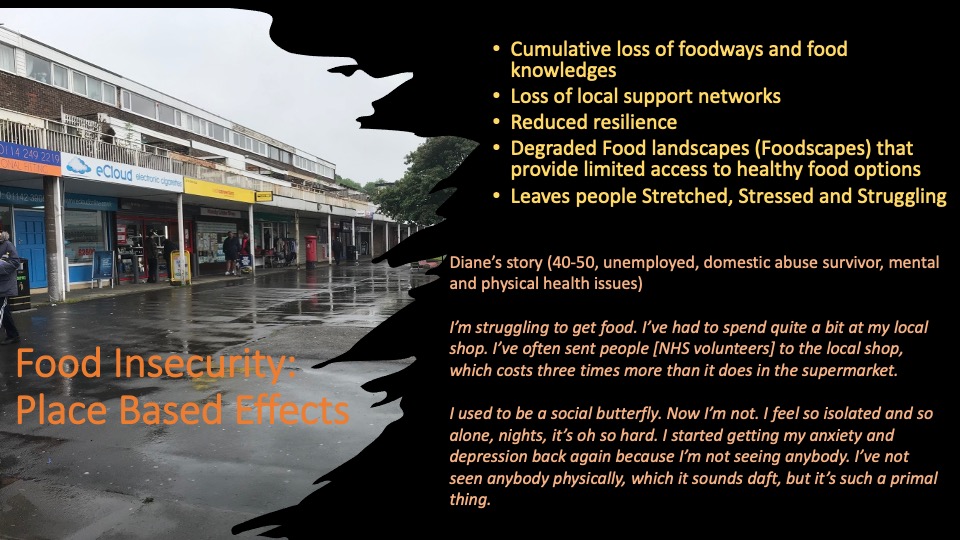
What happens is that places become hollowed out, and foodscapes are degraded. For those who live in these places, the struggle to manage increases. When people are facing a struggle, their physical health suffers, but so does their mental health.
There is much a supermarket can do to support people to access the food they need. For example, be willing to take a loss on some food items because they are important, keep a location open and provide low-cost but healthy food items because that is what people need and consider not the profitability of a single store or product line. This might involve asking what level of growth or profit is enough? Importantly, supermarkets have recently made decisions to limit their profits due to the cost of living crisis, so there is room for manoeuvre in this space.

But this is not something we should just leave to the supermarkets. For a transformed food system, we also need to generate diverse foodscapes. This means providing multiple avenues for accessing food that extends beyond and reduces our dependence upon supermarkets.

 GeoFoodie
You must be logged in to post a comment.