If you look through the door of my pantry you will see a window into my world. My pantry expresses my likes and dislikes and my cultural background by the presence and absence of certain goods. You will also see that in my house, we are not hungry. I have been hungry in the past. I plan against this by stocking up for the possibility that there might come a day when I might not have money. It isn’t an entirely rational approach to domestic food provisioning as it is a practice that produces waste. But, I always know where my next meal is coming from. And I also know I am lucky to be able to be so potentially wasteful. My household budget is shaped by my past experience of hunger. I am sure I am not alone, but for some reason hunger is not a fashionable term these days. What is that all about?
Tag Archives: neoliberalism
Seeing below
Hong Kong is a city of views. Upon arriving in Hong Kong one is assaulted with the image of the famous skyline. This commanding perspective offers a view of the top both literally and figuratively, if we also consider that much of that skyline represents the global circulation of things and money. Populated with 294 buildings over 150m tall (35-40 floors), and 2,354 buildings over 100m tall (New York only has 794), the city handily wins as being the place with the most opportunity to look down from above. But what do you see when you look down? Continue reading
Escaping poverty through low end globalisation?

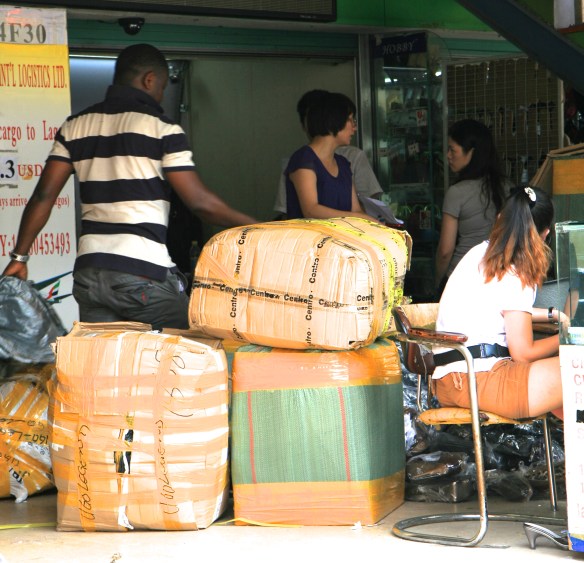
This photograph is taken in Guangzhou (the city once known as Canton) at a wholesale clothing market. Most of the people in the market are not from Guangzhou. The market traders are a mix of people from China and from a number of different nations in Africa. The customers are primarily Africans. It is an international place, drawing all toward a common goal: to escape poverty through the international circulation of cell phones and clothing. Continue reading
Integrity, Honesty and Orientalist Food Discourse
“Yes, getting people to eat healthy vegetables and fruits and other products from wet markets is important; but the sanitation side is complex and you face all the horrors of these markets coming from China. … But so much about these wet markets depends on what is grown and how and where. In Europe and the US where the movement toward markets is huge but with high sanitation controls and with farmers with some honesty, it is simple.”
I was recently having an email discussion with an American food scholar, who has written quite a bit on the nutrition transition. He was offering advice and sending helpful information and was broadly sympathetic to my argument about the importance of maintaining the wet markets. However, as you can see from the quote above, there are some real stumbling blocks of the discursive kind that bear further discussion and consideration. I was troubled by these words for a couple of reasons particularly. Continue reading


You must be logged in to post a comment.