Pledges, Missions and Food Security

The government has 5 missions:  Kickstart economic growth, Take back our streets, Break down barriers to opportunity, build an NHS for the future, and Make Britain a green energy superpower.  Food security is imbricated with all these pledges. 

Economic growth means good jobs and good jobs need people who can do them. This means having healthy people and being healthy rests on being food secure.

If you are food insecure, you are also isolated.  In communities where people are isolated, there is also greater fear of crime, disaffection and anti-social behaviour.  If we are going to take back the streets, we need to make spaces for communities to grow within them.

We know that children learn better when they are nourished.  Yet too many children live in families struggling to just eat, let alone provide the nourishment needed to build healthy bodies and minds.  It isn’t right that in a country as wealthy as this, so many of our children do not have the best chance that this wealth offers. 

Too much of NHS resources are taken up with treating diet-related illness and the issues linked to social isolation.  People with healthy diets and strong social networks live better and independently for longer, even with underlying health conditions.

If we allocate farmland to producing green energy, we are not producing the food that sustains us all.  We must ensure that we take a systems view so that our energy needs do not undermine our food security in the long term. 

Food insecurity in the UK is at an astonishing rate.  According to the FSA government statistics, in autumn 2022, 1 out of every 4 adults experienced low or very low food security at some point in the previous 12 months—meaning they were frequently cutting back on portions, skipping meals, or in some severe instances, skipping meals for whole days. Nearly half, 46%, of people with household earnings of less than £32K are food insecure. More than 1 in 3 adults, 36%, who have at least 1 child are food insecure- This vulnerability increases for those with 3 or more children. In areas in the most deprived quintile, two out of every five, 40% of adults are food insecure. 

My research focuses on improving people’s ability to have the food they need to live their best lives and how places—the communities where people live—can foster health and well-being or create barriers that isolate and disable. 

With this in mind, and building on the UN’s 4 pillars of food security and resilience theory, I have created a framework called food ladders to help structure how people and organisations (public, private, and third sector) can collaborate in local places to increase the resources that are needed to be food secure.  (hand out materials).

The UN sees food security as more than just a financial issue.  Food access is financial, but it is also linked to legal and structural barriers.  Food security is also about availability—the food people need for a healthy and fulfilled life, which is available where they live without undue stigma, stress, and struggle.  It is also concerned with utilisation—do people have resources, including money, knowledge, know-how, tools, and mental and physical states, to utilise the available food they can access?  And fourth, is this all consistent and sustainable for the future?

When you are wealthy, you can have healthy meals delivered, but this is not an option for most of us all the time. We need other resources like having a shop we can walk to, an able body that lets us carry our food home, a home with a kitchen and tools that work, knowledge about what different foods are and how to cook them, and the head space to be able to do all that. 

Health is negatively impacted when people are food insecure, leading to a downward spiral of deeper food insecurity.  Repairing is much easier when people are not in crisis or have never been. 

How we organise food support makes a big difference to who and how people use it and what they can get from itFood gets people in the door.  When they come back, more support will be provided.  So many of the organisations I have worked with talk about how this.   Yet, we know that one of the most significant barriers is getting people the support they need, and there is a lot we still don’t know.  But what I do know is that there is a big difference between a food club and a food bank or a social eating space and a soup kitchen, and this has to do with how values are expressed through the ways that food is made available.

The Food Ladders offer a three-rung approach to capitalise on these differences. 

  1. Catching for those who need immediate support, but we don’t want people to keep coming back to this rung. What we want is for people to move to rungs 2 and 3. 
  2. Capacity building enhances the assets and resources people and communities already have and contributes to those that they don’t
  3. And finally, self-organising activity that increases sustainability and removes or redistributes vulnerability to make a fairer society. 

One organisation (of many) I work with, TBBT, facilitates food clubs across 124 community locations, mainly in the north of England.  We did a survey with members that resulted in more than 9k responses.   We found that as a result of using the club, people reported

  1. Increased fruit and veg uptake
  2. Cooking more healthy food at home
  3. They also get involved in food talk with club members and build friendships.  The majority say they feel less alone and feel more involved in their communities. These friendships turn into mutual aid. During lockdown, people shared advice and checked in with each other through WhatsApp groups. 
  4. The majority had not used any food support before using the food club, but of those who had said they used a food bank, most said they used them less frequently or stopped using them altogether. 
  5. We know that when we have thriving communities, the fear of crime decreases.  Food activities such as food clubs and social eating spaces support thriving communities.  To take back our streets, we need to make space for people on those streets to intermingle and eat together.  

Despite this and the increases in these activities, our communities are dominated by interventions that do not increase food security capability.

To facilitate food ladders, we need:

  1. More resources and industry collaboration for community food programmes that don’t reinforce the status quo but instead build capabilities at rungs 2 and 3. 
  2. A national mandate and funding for local food strategies.
  3. Investment in social development programmes to ensure that people have the capabilities to live a healthy life.
  4. Adequate incomes that offer living wages and advancement opportunities, with a safety net for those who cannot access work.
  5. Free school meals for all children in state schools would be great, but at a minimum, lifting the earnings threshold should be a priority.
  6. A review of business rates such that those businesses that predominantly offer healthy foods are not disadvantaged because they have more risk compared to those who offer few healthy foods. 

And finally, I offer a plea for better data with larger sample sizes.  Without understanding, we cannot produce insights that lead to change.
5–8 minutes

Ultra Processed Food, Stomach Share, and the Problem of Food Contexts

Ultra processed foods are in the news more and more. A recent meta-study found there are a myriad of health issues linked to diets comprised primarily of such foods. When thinking about the level of processing, foods are typically categorised into 4 groups: unprocessed or minimally processed, processed culinary ingredients, processed foods and ultra-processed foods.

Processing is not a bad thing in and of itself. Pickling, fermenting, canning, even chopping and cooking are processes. We process things to turn them into food at home, in restaurants and in factories. Ultra-processed foods are distinctive in that they change the nature of the original ingredients, such that very little of the original whole food is left, and they include chemicals that you would not find in an ordinary kitchen. These include emulsifiers, artificial colours and flavours, stabilisers, sweeteners, and other additives to make them taste better and last longer. They also are fatty, salty or sugary and lack dietary fibre. What we might think of as empty calories.

Ultra-processed foods are also less expensive and, because they last longer than fresh foods, are less risky for a tight household budget. But we pay for this low cost in other ways. Individually, we pay for this food with our health. We also pay collectively, if somewhat unevenly, for it with the environment. Ultra-processed foods drive mono-crop production that undermines ecosystems and harms biodiversity. The processing is also energy-intensive and dependent upon petrochemical inputs, thereby contributing to climate change.

We can tell people to stop eating these foods, but educational campaigns won’t work on their own. People need to have the capability to eat differently. If those foods that are better for you are not available in the place where you live or they are too expensive then all that the education will do is create further feelings of guilt.

Ultra-processed foods are a key part of a system that rewards producers for creating these foods in the form of profits now, whilst undermining our global food security now and into the future. Because this is a systemic problem we need systems solutions that intersect at all points of the supply chain and operate at different scales. Introducing disincentives for the production and sale of ultra-processed foods, shifting to agroecologiecal farming practices, and re-introducing these better foods into neighbourhoods all need to be considered.

I recently participated in a webinar by Healthy Diets Healthy Life (HDHL) as part of the European Commission’s Bioeconomy Changemakers festival. In addition to learning about HDHL and hearing two other speakers talk about ultra-processed foods from a bio-economy and a nutrition perspective, I talk about the contexts within which people access and purchase food. My section starts at about 38 minutes in.

webinar on ultra-processed food

So what can we do right now? We can pressure government to put constraints on the way those in the food sector operate and provide incentives to act in a way that is better for both health and the environment. Individually, we can also try where we can to introduce more foods into our diets that replace the ultra-processed foods we currently eat. As a society, including commercial organisations, we can also support initiatives that help people by expanding their access to and knowledge of those foods that are better for them, which do so in non-stigmatising ways. I talk about two such initiatives in the video.

Let’s talk about Food Deserts.

Video

A short video about food deserts and how they come about from a consumption perspective.

People make rational choices within the constraints of their choice sets. Choice sets are constrained by the resources they have at their disposal, such as skill, time, mental and physical health, and money. These choice sets are also constrained by the physical and social conditions of the place in which they live, broader institutional contexts and their own social positionalities.

When there is a concentration of people making similar decisions based on similar circumstances, demand for an item, such as healthy food, decreases.

At the same time, food retail operates within a system where profit-making is the main priority. When an item ceases to have sufficient demand to maintain its profitable status, it is usually dropped from the range of products offered. Shops close when the ability to profit at the store level is insufficient compared to other store locations.

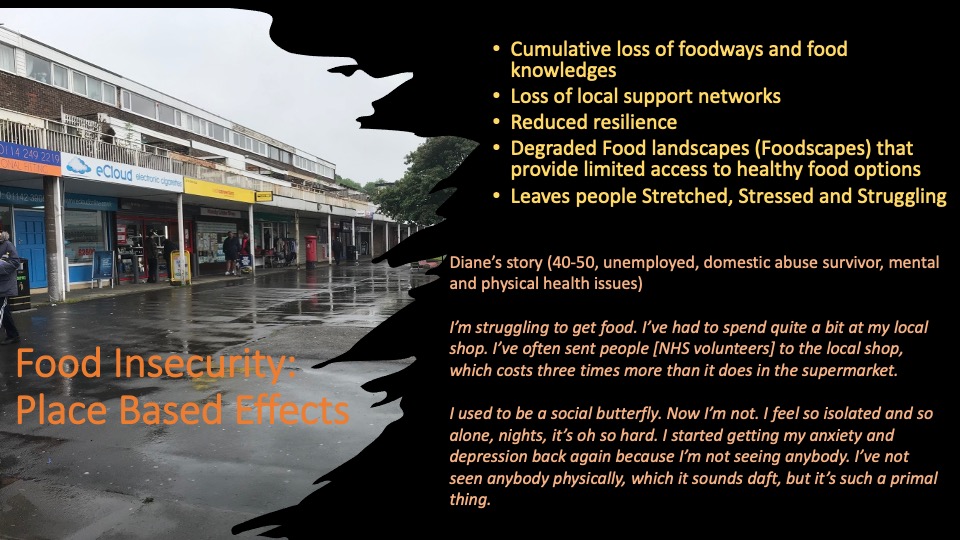
Slide demonstrating the effects of living in a food desert

What happens is that places become hollowed out, and foodscapes are degraded. For those who live in these places, the struggle to manage increases. When people are facing a struggle, their physical health suffers, but so does their mental health.

There is much a supermarket can do to support people to access the food they need. For example, be willing to take a loss on some food items because they are important, keep a location open and provide low-cost but healthy food items because that is what people need and consider not the profitability of a single store or product line. This might involve asking what level of growth or profit is enough? Importantly, supermarkets have recently made decisions to limit their profits due to the cost of living crisis, so there is room for manoeuvre in this space.

Source: This is money. 7 May 2023

But this is not something we should just leave to the supermarkets. For a transformed food system, we also need to generate diverse foodscapes. This means providing multiple avenues for accessing food that extends beyond and reduces our dependence upon supermarkets.

Reparative Horizons for a food secure future: Call for abstracts RGS-IBG annual international conference

We are requesting expressions of interest to join a paper session at the RGS-IBG sponsored by the Food Geographies Research Group.

How do we make reparative horizons visible for communities and households in food crises?

The current contexts within which people eat, survive and support each other are structured to reproduce the inequalities that produce vulnerability to food insecurity. While we cannot undo the past, we must learn to identify these structuring features and envision reparative horizons characterised by imagination, aspiration and social justice.  To move between the present and the horizon requires an active mapping of the spaces in-between–or transitional spaces– that allow people to navigate toward those horizons.

To ensure that these futures are socially just, those vulnerable to food insecurity need to be included in the visioning and production of these horizons. Yet placing additional demands on those who encounter issues with food security and its associated isolations introduces further burdens in an already over-burdened and under-resourced life experience. As a result, the immediate occupies the mental and physical spaces of survival. As such, these individuals and their communities often struggle to envision their participation in a good food future. This affects both those living with and those supporting issues surrounding food security. In this session, we ask how we can envision, reveal and create those paths and maps that allow socially just visions of sustainable and food-secure futures to take shape and take place.

We invite empirical, theoretical, and conceptual papers around the following questions, although other ways of approaching the subject are also welcome.

  • What is the role of imagination and creativity in producing these horizons and the landscapes that lead to them? 
  • What role do intermediate spaces play in creating transitions toward socially just food futures?
  • What is holding people and places back from envisioning these reparative horizons and producing the interstitial spaces between the present and these futures? 
  • How can isolation be a barrier to envisioning food-secure futures, and how might the community be mobilised to materialise reparative horizons and the spaces between the here and now and the there and then? 
  • How might we rethink our approach to researching in and with communities to understand and co-create these interstitial and horizon spaces and the maps that help us navigate between them?

We are hoping for 15-minute, in-person presentations with plenty of time for discussion. Please send a title, 250-word abstract and your full contact details to Megan Blake m.blake@Sheffield.ac.uk and Ollie Chesworth ochesworth1@Sheffield.ac.uk by 16 February. Please include “RGS reparative food horizons” in the subject. We will aim to inform those accepted for the session by 23rd February and will send you the link you need to submit your abstract.

AC2024 will take place in London at the Society and Imperial College London and from Tuesday, 27 to Friday, 30 August 2024. 

Please note the RGS participant regulations:
“Delegates will be limited to ONE paper presentation and ONE panel/workshop contribution, OR, TWO panel/workshop contributions. The role of discussant is included as a panel/workshop contribution”  https://www.rgs.org/research/annual-international-conference/call-for-sessions-papers-and-posters/guidance-for-presenters