There is growing recognition that the UK needs to build greater food resilience. Tim Lang’s recent work is important here. It makes a compelling case for readiness: shorter supply chains, diversified sources of production, and stronger capacity to withstand shocks. That matters enormously. But readiness on the supply side is only half the story.
Food resilience is a two-sided platform problem.
It is not enough to ensure that food exists, or even that it reaches shops, distribution hubs, or community outlets. We also have to ask whether people can access that food in ways that allow it to become nourishment, care, and everyday security. Just because food is available does not mean it will get to the people who need it. And even if it does, that still does not guarantee it can be stored, cooked, shared, or eaten.
This is where community resilience comes in. As I argue in Building Resilience: The Role of Food Clubs in UK Food Security, food security is not only about what is in the system. It is also about whether people have access to community-based infrastructures that allow food to be obtained, stored, cooked, shared, and eaten in ways that support everyday life. Food clubs are one example of this broader resilience architecture.
In economically wealthy contexts such as the UK, the dominant mechanism through which people access food is through purchase in a market system organised primarily around profit maximisation. For many people, this works well enough most of the time. But it is also a fragile arrangement. It assumes that households have enough money, enough time, enough equipment, enough energy, enough transport, enough storage, and enough practical capacity to turn food into meals. When any of these are disrupted, access breaks down, even when food is technically present in the system.
That is the blind spot in many discussions of food resilience. We talk about supply, but not enough about access. We talk about availability, but not enough about use.
A resilient food system therefore needs more than diversified production. It also needs diversified consumption mechanisms: multiple ways for people to obtain and use food beyond the narrow logics of maximising sales and extracting profit. This may still include purchase, but through models where surplus supports sustainability rather than endless growth. It may also include sharing, gifting, barter, mutual aid, community growing, food clubs, social eating spaces, and other collective infrastructures of access.
Amartya Sen helps us think about this differently. What matters is not only whether food exists as a commodity, but whether people have real opportunities to access it through different means. These could include buying, but also sharing, gifting, own production, barter, or community exchange. I think of these as access channels: the practical routes through which food becomes available in everyday life.
This matters because highly “efficient” systems are often only efficient from the perspective of profit. They may be efficient at moving products, cutting slack, and concentrating market power, while being deeply inefficient for people, place, planet, and even food itself. If food is produced and distributed in ways that cannot be reliably turned into sustenance where it is needed, then the system is not truly resilient.
Building alternative access channels does more than help people at the margins. It strengthens the whole system. When households and communities have multiple ways to access food, they are less exposed to shocks in any single channel. And when non-maximising forms of provision exist alongside profit-driven ones, they also put pressure on the mainstream system to respond differently. They force greater attention to health, wellbeing, justice, and sustainability.
So yes, we need shorter supply chains and diversified production sources and methods. But that is not sufficient. We also need community resilience and diversified access channels. Food resilience is not just about making sure food is there. It is about making sure people can actually get it, use it, and benefit from it.
If we forget that, we risk building a food system that is ready for disruption in theory, but not resilient in practice.
I recently had an interview with a reporter from The Grocer about the role of food clubs in the UK. A food club is not a food bank. Instead it is a low-cost, community-based food project that makes available food that is often donated by retailers and food producers. The food is within date, but frequenlty short-dated, so not suitable for sale at the usual outlets. These community food clubs are place-based and utilise volunteers who are also frequently members of the service. The impacts from food clubs is more than just low-cost food. I would place food club activity at Rung 2 of the Food Ladders. You can read the article here:
The Grocer is a well-established British trade publication focusing on the grocery retail market. Its purpose is to provide news, analysis, and data related to the UK grocery industry. It caters to professionals working in food and drink retail, from supermarkets to independent stores. It covers market trends, product launches, pricing and industry news. It has been publishing since 1862.
I read the newspaper this morning, and like yesterday morning, most of what I saw was crisis talk. With good reason. Wars and conflicts are multiple. The increase in frequency and magnitude of weather events (which are scientifically linked to climate change) results in large numbers of deaths and longer-term effects such as loss of property and livelihoods. Once vibrant communities struggle to recover.
These events have long-lasting effects. Hurricane Helene, which struck North Carolina (USA) at the end of September, illustrates this. My mother, who lives in a retirement community, is safe, but one month still does not have drinking water. She tells me it is difficult, but it is okay, given they have electricity and broadband service now. She says her inconvenience is minor as hundreds of people remain missing in Asheville. One resident described it as a post-apocalyptic landscape.
We also have what seems like three patterns of crisis —The sudden and many catastrophic crises that seem to happen without warning, the crises that emerge out of political and ideological differences, greed, and a desire for control, and then the quiet and persistent crises that become a way of life for so many who have just had the misfortune not to be able to reside among the wealthy and powerful. Or maybe they are all just manifestations of the same thing.
“Anti-imigrant sentiments, nationalist populist authoritarianism, militarised security discourses, racist policies, regressive gender politics, and climate change denial (or hostility) are linked, whether in the United States, Italy, Inda, Hungary, the Philipeans, Brazil, Israel, or Poland. …The global economic system is ever more integrated under neoliberalism, hostility to immigrants and refugees is high. Economic inequality has reached levels never seen before in any period of human history. …Interwoven are crises of modernity (including declining faith in technical authority and scientific knoweldge, attacks on media institutions, and the winding down of the American centry (albeit with bellicose American exceptionalism denying its demise).
The moment of crisis is the moment of rupture. Domiant belief systems and ideologies that dispute them come into view, or sharper relief.
Starting from the premise that environmental damages are interwoven with political and social conflicts, … how organisers, communities, and movements fight, survive, love, and create in the face of environmental and social violence that challenges the very conditions of life itself.” (Sze J. Environmental justice in a moment of danger. University of California Press; 2020, p. 2-4)
I teach a module at the University of Sheffield called Social Justice in the Time of Crisis. We introduce notions of crisis and consider how these are made within the contexts Sze discusses. We also talk about justice. Do we want to live in a perpetual crisis, or are there ways to move beyond and redesign a system that has produced the crises we are now experiencing? This is a discussion of world views and what social relations should look like. It requires an understanding of ethical perspectives on what is right or just. We don’t all hold the same views, and understanding and thinking critically about where we stand on the fundamentals is imperative for how we decide to proceed. Knowing this helps us to answer some fundamental questions such as who gets what? To what extent can people live the lives they can reasonably consider to be valuable? What is the role of recognition? Who should be involved in making decisions and who are we asking to make decisions for us?
I was speaking to someone recently who claims to not “do politics” while at the same time progressing the understanding that to be a socialist is a bad thing. It turns out he did not actually know what socialism entails. This is a man who is caring and kind to others. Works in a care home for people with dimentia.
In the remainder of this post, I first unpack different approaches to justice. and then I reflect on the US election and the 2024 UK budget. The use of the terms conservative and progressive does not refer to specific political parties per se, but instead, ideologies that have been termed conservative and progressive. These terms existed long before the specific parties, although the parties do align (sometimes loosely, sometimes more tightly) with these ideologies.
What kind of justice?
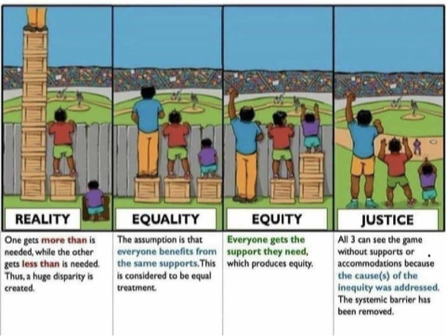
Conservative justice starts from a position that people deserve what they get. It is a merit-based form of justice, whereby what you deserve or don’t is based on what you have done. There is no recognition of how past social inequalities linger and shape intergenerational outcomes in this view, nor of how social norms ask certain groups to disproportionately do the unpaid work of care that limits their ability to engage with paid work. There is also no recognition of a public good. The foundational belief is people should be able to keep what they have earned and then pay at the point of use for those things they want. A belief that we should not have to pay for school meals, childcare, or education if we do not have children is an example of such thinking. This thinking fails to recognise that we all benefit from having well fed and educated children. There is a focus on equality, whereby everyone is treated the same way, regardless of the myriad differences that make us human. This is in stark contrast to equity, where people are provided with what they need to succeed. Everyone should not get the same because our needs are not the same.
While equity is an essential first step in achieving progressive justice, it is insufficient because it does not acknowledge that past injustices have effects that linger into the future and create barriers that require dismantling. Progressive justice is about improving social conditions or making a better world. Drawing on Rousseau, progressive justice also recognises that the social order (e.g., class structure, conventions on behaviours linked to gender) does not come from natural selection but instead is founded on social conventions that have given advantages to some and, therefore, work for those who benefit and disadvantages to others and as such do not work.
Progressive justice also depends on recognising that we only achieve the position and value we have because others recognise that value. If I refuse to acknowledge your position, I am also denying your position. A president only has authority if people grant them that authority. Where conservative justice fails is that it does not acknowledge this fact. Hegal argues that acknowledging this fact of recognition is (part of) what creates society. He contends that we only achieve our own autonomy through mutual recognition–I recognise you as someone who has the authority to say that I have status. The irony of freedom is that we cannot be free except in terms of our relations with others and through being in society.
Humans desire and need to receive and give recognition because it helps us to have a sense of ourselves. We commit acts of moral violence through misrecognition and denial, such as when we deny rights or refuse social inclusion. People who experience this moral injury experience indignity and are denied self-hood, which is the core experience of injustice. Recognition creates community.
So what does this mean for crisis?
To mitigate crisis, we must prevent it before it happens and eliminate vulnerabilities. This cannot occur through conservative justice that reifies individualism, sees difference as rooted in a pre-given (god given?) natural order, and starts from a position that people deserve what they get. Real human progress can only happen if we acknowledge the community’s central role. Among the stories of difficulty and hardship that resulted from Hurricane Helene, there also emerged quiet stories of care and community. People hauled water for those who could not do it themselves. Food was shared with those who were without. People opened their homes for those lacking shelter. These are not stories of conservative justice, but of progressive justice and illustrate that we all benefit from a society that breaks down barriers that limit the capabilities of people to thrive and succeed.
On Tuesday, 5 November, there is an election. The only way to achieve a better world is to evaluate those running for political parties on a justice basis. Even when choices are not perfect, a balance in favour of progressive justice is progress. Indeed, candidates that call for individualism, maintenance of hierarchies established in the past and their corresponding misrecognition can only lead us into more profound crises, which, without community, we will not survive.
Today’s news also included the key takeaways from the UK Budget. People have been talking about this for some time now and there will be more talk, no doubt. The doubters will be angry, regardless. But I contend that much of this doubt stems from a lack of understanding about the ethical underpinnings. The budget increases taxes by £40 billion. A big number even in national budget terms. Beyond understanding in household budget terms. But the importance is in the how not the what.
The minimum wage will increase for those over 21. This will increase tax takings because incomes will be higher for so many (and yes, businesses will say it cuts into their ability to survive and for some, it will, but for many, it will just mean the bonus to the big boss may not be so high. I’ve written about this elsewhere). It will also impact charitable organisations and social enterprises that deliver so many of our community services, which is worrying. One of the groups most vulnerable to food insecurity is young people. A decent wage is necessary for a healthy diet and wellbeing. A healthy workforce is also more productive.
Employer national insurance is increasing. This, again, is a benefit to society because National Insurance pays for health care. A healthy workforce is also more productive. Universal Health Care benefits us all and is a public good. You may not need it now, but in all likelihood, you will one day.
Capital gains tax will be more in line with income tax from employment. Many who pay themselves through dividends do not pay income tax, and they have been doing this to avoid paying taxes. Most people with lower incomes do not have the option to take dividend payments. This progressive tax increase asks those who are more advantaged to pay a bit more of their share.
The conservative party froze tax band thresholds for those who receive wages. These will rise at the rate of inflation from 2028. This is progressive as it acknowledges that it is more expensive to be poor compared to being rich.
Those who are sick and disabled will get an increase in benefits. Current rates create a bare life for many. This will go a little way toward increasing the opportunities for people who are sick and disabled to be able to thrive.
Carers’ allowance income thresholds will increase, and the unpaid work people do to care for others will save the public purse a lot of money. Pushing them into or keeping them in poverty only undermines their health. This is progressive.
The household support fund is to increase. This is generally good, as so many local authorities are using some of this money to build community interventions that increase resilience (for example, by funding interventions at rungs 2 and 3 of the food ladders. However, I am not convinced by the cash-first approach that has also been used because I do not see it as a human development approach, as I’ve elaborated here and here.
Fuel duty will be frozen at 5p.
The duty on draft beer will go down by 1.7%. It remains to be seen if this will extend to the customer or even the pub landlord. Let’s wait and see.
Tax on cigarettes, tobacco, and vaping will increase. From a public health perspective, this may be a good thing as it is thought to encourage people to cut back or not start. However, a large number of smokers get their tobacco from abroad, where they are much cheaper. People who go away bring them back for their smoking friends.
VAT will be charged on private school fees. One effect will be that these schools will become even more elite as those who can only just afford to send their children to these schools will no longer be able to do so. However, these children will still need to go to school, and this will push these children into state schools, which may not be a bad thing. The budget also has money to rebuild or replace schools that are not fit for purpose. This feels like a progressive policy in the round.
The budget for school breakfast clubs will be increased. I’m torn on this one. Breakfast clubs can be good and help a lot of children. I would rather see the funding go toward an uplift in the threshold for free or universal free school meals. However, if this latter were to happen, we would need a new mechanism for calculating the pupil premium.
Increased spending for those children with special education needs. This is progressive in that it can reduce the barriers that SEN impose on people’s life chances and their ability to thrive in later life.
HS2 between West London and Birmingham will go ahead. It is not my first choice for public spending, but I can see some benefits.
Tax on private jet travel will increase by about £450 per passenger. The hope is that this will reduce such air travel. This has positive environmental implications, and it is unlikely to impact those who struggle the most.
The soft drink levy will go up. Again, there are health implications. However, it pushes such beverages into luxury product territory.
Overall, this is a much more progressive budget than expected and that we have seen in a very long time. It is likely to impact those who can afford it much more than those who can least afford it.
On the 10th of September 2024 we launched the Food Ladders Toolkit. The event was held in Lambeth at the Community Shop. Food, based on the food stories of people who use Community Shop, was cooked for us by community members. It was absolutely fantastic. We want to thank all those who helped with the day and those who came and joined us.
If you were unable to join us for the launch and would like to know more, there will be a webinar on 1 October 2024, this time hosted by Sustainable Food Places. I will be talking about the food ladders and will be joined by Mark from The Bread and Butter Thing, another organisation that uses the Food Ladders to structure their support. The link to the event is here.
So why do we need a toolkit?
People in wealthy and poor countries struggle to have the food they need to live their best lives. The reasons for this are complicated. There is a mix of individual, group, community, and national factors. The food ladders is a framework to help communities, service providers, local government, and others develop an understanding and a pathway toward a food system that meets community members’ needs and desires, both now and in the long term.
We can’t expect communities that are already struggling to be able to do this on their own, but we also cannot do it without them. Building something new is hard work. It takes commitment and motivation. This toolkit aims to support those who can help to be able to do so. This toolkit is primarily aimed at those in local government and local food networks. There will be elements that community organisations may also find helpful. It is not a toolkit for those who are struggling.
The toolkit is based on interviews we conducted with about 30 people working in local governments across England. We wanted to understand how people were using the framework. In particular, we wanted to understand its utility and also where the difficulties might be. We found that organisations and local authorities across the UK use the framework to structure their planning and approach to community development, community resilience, health, and poverty. Local authorities using the framework have shifted to partnership working, with public consultation happening at the start of the process rather than toward the end. We learned about joined-up support networks in these places that cut across a variety of projects and organisations who come at the issues from a multitude of different directions. We saw an understanding of how places are designed, how we engage with people, and how we communicate with each other creates positive change.
But we also found several areas where this process can be complicated. Food work touches on multiple departments within a local authority, and coordinating that is needed. Motivation and momentum can flag. Sometimes, community members meet the effort with scepticism. Sometimes, we lose sight of the vision or forget to clearly define what we are building toward. Sometimes, messages are misunderstood. To help with this, we have created workshops, case studies, videos and diagrams and currated links to the work of others that we feel can help overcome these difficulties.
I hope that these tools will be helpful. If you think a tool is missing, please do not hesitate to get in touch with me. Likewise, I would love to hear stories about how the Food Ladders is being used in your area. You can use the form below to do so.




 GeoFoodie