

In 1958 Raymond Williams wrote, “Culture is Ordinary”. In this essay, and indeed throughout his writings, he urges us to understand culture as firstly not something else some exotic other has, nor, secondly, something that only the wealthy possess. For Williams, and I concur, we all have culture. We express it in the everyday practices of doings and sayings that connect us with those with whom we come into contact, whether that connection is one that emphasises sameness or difference.
The way we do our culture is a combination of how we use the resources available to us and what we learn and remember to achieve a particular end. Sometimes that results in performances of acts and sayings that resemble those performed and acted by others, sometimes it is a performance that is new, or that slightly alters what others before us have done. Culture is not fixed and static, it is alive and creative even in its banal everydayness. In all these acts, culture is the performance of the values held by the performers. These practices of culture make society.
In this photograph the shop keeper is resting after a day’s work, even though it is mid-day. He arrives every morning well before light to unload and then sell fruit at the fruit market. When the market is in full swing, he haggles and negotiates price. This is an affable affair. He and those who buy from him seek the best price. Everyone else, as with him, according to an unwritten script knows this process. He knows what roles to play, where to push and where to give. There is a skill and knowledge, born out of years of experience. There is camaraderie. Sometimes there is corruption in the kickback that must be paid to the gangs who run the men who unload and load the trucks. After he rests. This is his routine. If you look around the market you will see others performing their routines in a similar way.
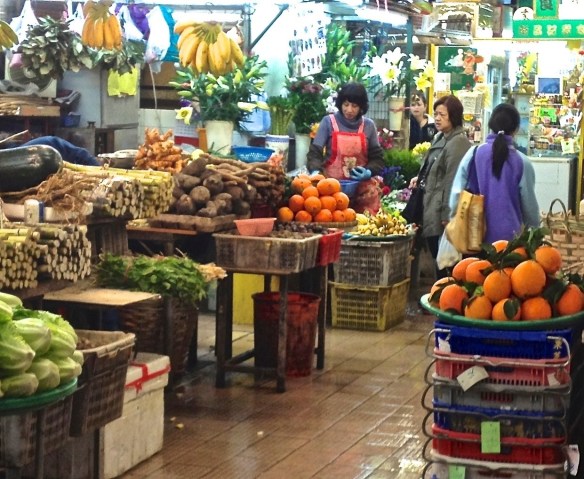
If you follow the fruit to the retail markets you will see a new set of practices being performed. Men and women unpack the fruit from the boxes. They fold them and stack them and make them available for the armies of elderly people who will come and collect the cardboard to be recycled. These are neighbourly acts of care performed in a context that doesn’t institutionally support those who are too old to work.
Unpacked, the fruit is wiped and displayed attractively, awaiting the housewives from the poor neighborhoods and the maids who work for the wealthy to come make their purchases. The haggling will commence, but only so far. Everyone is aware that profit margins are low as are incomes. When maids are buying for the wealthy, there is still constraint as these women are held accountable for every penny they spend. These women know they must show receipts and get a good price or they will be accused of poor stewardship and may be fired.
People find ways to give away to those with less. Bruises on fruit are found or hidden and prices established depending upon the relationships between buyer and seller. Without the markets those with few resources will suffer. There is no sliding scale at the supermarket. There is no way to recycle boxes to the elderly or less attractive food to the poor. These values are enabled by a food system that gives importance to freshness in its food and appreciates personal relationships. These places where the fruit dwells and then moves on. They are sites of resistance to the tide of neoliberal practices and institutions that seek to impose individualisation, profit over people, and a form of fairness that only benefits the wealthy. Culture is ordinary, but plays out in ways that are extraordinary.

I have written more on Ya Ma Tei Fruit Market, where this photo was taken. You can read it here. There is more about the elderly and box collecting in another post here.
Ben Highmore in his instructive book, The everyday life reader, has written a chapter that concerns Williams’ contribution to cultural studies. The full reference to that is as follows:
- Highmore, B. 2002. The everyday life reader, London and New York, Routledge.
This post was written in response to WordPress’s Weekly Photo Challenge. The theme is culture. You can find the link to the challenge here.
How to reference this post in non-web publications. If you would like to cite this post I suggest the following format:
Blake, M (2013) Culture is Ordinary https://geofoodie.org/2013/04/27/culture-is-ordinary/ Geofoodie.org 27 April 2013 (Accessed: XX/XX/20XX)
Related articles
- Ubuntu (I am because we are) (nadyafauzia.wordpress.com)
- Hidden Millionaires: Lessons From Unconventional Money Management (quicken.intuit.com)
- Pious Guff (conradbrunstrom.wordpress.com)
A few other posts that respond to the Photo Challenge:
- http://chrisbreebaart.wordpress.com/2013/04/27/weekly-photo-challenge-culture-lost-in-translation/
- http://travelsandtrifles.wordpress.com/2013/04/27/weekly-photo-challenge-culture-travel-theme-light/
- http://happymonkeyland.wordpress.com/2013/04/27/weekly-photo-challenge-culture/
- http://eagerexplorer.wordpress.com/2013/04/27/weekly-photo-challenge-culture/
 GeoFoodie
You must be logged in to post a comment.