Many of you will know that I do a lot of research focusing on Rung 2 of the Food Ladders. One of these organisations is The Bread and Butter Thing. I’ve known Mark and Jane since they founded the Food Club in about 2016. In 2019 we did our first member survey. I was a bit tired of the narrative around saving money. My view is you can’t save what you haven’t got in the first place. I wanted to explore the extent to which some of the benefits I had heard about qualitatively were being experienced (A classic example of the benefits of mixed methods or combining intensive and extensive research see table on page 14).
That first survey was the first one to highlight the social benefits attributed to food clubs and the extent to which members experience them (a report is available here). At the time there were just under 8000 TBBT members located in sites primarily across Greater Manchester. And although you won’t see references to this report in the reports from other food club umbrella organisations, the report was shared with them and makes up key impact measures for the sector.
Since that initial survey, TBBT has done an expanded annual members survey. From fairly humble beginnings of a survey that included about 300 responses to just a few questions, the 2024 survey has about 9.5K responses (from a population of about 80K) to a wide range of questions about people’s circumstances, how they are getting by, and how they percieve the impact of joining TBBT has been for them (Some highlights are here). This remains the only large-scale data source that is collected directly from to food club members. I have been proud to have been able to help with this and provide some analysis of the data. I have never managed to find the time to pull out all the rich insights that are buried within. One day, hopefully.
Mark and Vic recently asked me to join them for a podcast (which turned into two!) to talk about the results of the survey for this year. Vic joined TBBT toward the end of the lockdown period. Prior to that she worked for Manchester Council and when the pandemic hit she coordinated their food response brilliantly. Mark introduced me to Vic and we had many discussions about how best to meet the needs of people in Manchester depending upon their circumstances. I have written about that work in a book chapter about food security resilience under Covid 19 that appears in a book called Living with Pandemics.
The podcast, called a Slice of Bread and Butter, usually involves a conversation with a member and then a bit of discussion. These are fascinating insights into the determination and buoyancy of members in the face of struggle. They demonstrate how precarious life can be and how vulnerable most of us are to finding ourselves in similar situations. I encourage you to follow the podcast. They are available on all the major podcast sites and also on the website linked above.
Here are both episodes where we talk about just a tiny proportion of survey findings and how they reveal just how much food clubs, like TBBT, that are carefully curated, organised and managed can make a difference.
I recently had an interview with a reporter from The Grocer about the role of food clubs in the UK. A food club is not a food bank. Instead it is a low-cost, community-based food project that makes available food that is often donated by retailers and food producers. The food is within date, but frequenlty short-dated, so not suitable for sale at the usual outlets. These community food clubs are place-based and utilise volunteers who are also frequently members of the service. The impacts from food clubs is more than just low-cost food. I would place food club activity at Rung 2 of the Food Ladders. You can read the article here:
The Grocer is a well-established British trade publication focusing on the grocery retail market. Its purpose is to provide news, analysis, and data related to the UK grocery industry. It caters to professionals working in food and drink retail, from supermarkets to independent stores. It covers market trends, product launches, pricing and industry news. It has been publishing since 1862.
I read the newspaper this morning, and like yesterday morning, most of what I saw was crisis talk. With good reason. Wars and conflicts are multiple. The increase in frequency and magnitude of weather events (which are scientifically linked to climate change) results in large numbers of deaths and longer-term effects such as loss of property and livelihoods. Once vibrant communities struggle to recover.
These events have long-lasting effects. Hurricane Helene, which struck North Carolina (USA) at the end of September, illustrates this. My mother, who lives in a retirement community, is safe, but one month still does not have drinking water. She tells me it is difficult, but it is okay, given they have electricity and broadband service now. She says her inconvenience is minor as hundreds of people remain missing in Asheville. One resident described it as a post-apocalyptic landscape.
We also have what seems like three patterns of crisis —The sudden and many catastrophic crises that seem to happen without warning, the crises that emerge out of political and ideological differences, greed, and a desire for control, and then the quiet and persistent crises that become a way of life for so many who have just had the misfortune not to be able to reside among the wealthy and powerful. Or maybe they are all just manifestations of the same thing.
“Anti-imigrant sentiments, nationalist populist authoritarianism, militarised security discourses, racist policies, regressive gender politics, and climate change denial (or hostility) are linked, whether in the United States, Italy, Inda, Hungary, the Philipeans, Brazil, Israel, or Poland. …The global economic system is ever more integrated under neoliberalism, hostility to immigrants and refugees is high. Economic inequality has reached levels never seen before in any period of human history. …Interwoven are crises of modernity (including declining faith in technical authority and scientific knoweldge, attacks on media institutions, and the winding down of the American centry (albeit with bellicose American exceptionalism denying its demise).
The moment of crisis is the moment of rupture. Domiant belief systems and ideologies that dispute them come into view, or sharper relief.
Starting from the premise that environmental damages are interwoven with political and social conflicts, … how organisers, communities, and movements fight, survive, love, and create in the face of environmental and social violence that challenges the very conditions of life itself.” (Sze J. Environmental justice in a moment of danger. University of California Press; 2020, p. 2-4)
I teach a module at the University of Sheffield called Social Justice in the Time of Crisis. We introduce notions of crisis and consider how these are made within the contexts Sze discusses. We also talk about justice. Do we want to live in a perpetual crisis, or are there ways to move beyond and redesign a system that has produced the crises we are now experiencing? This is a discussion of world views and what social relations should look like. It requires an understanding of ethical perspectives on what is right or just. We don’t all hold the same views, and understanding and thinking critically about where we stand on the fundamentals is imperative for how we decide to proceed. Knowing this helps us to answer some fundamental questions such as who gets what? To what extent can people live the lives they can reasonably consider to be valuable? What is the role of recognition? Who should be involved in making decisions and who are we asking to make decisions for us?
I was speaking to someone recently who claims to not “do politics” while at the same time progressing the understanding that to be a socialist is a bad thing. It turns out he did not actually know what socialism entails. This is a man who is caring and kind to others. Works in a care home for people with dimentia.
In the remainder of this post, I first unpack different approaches to justice. and then I reflect on the US election and the 2024 UK budget. The use of the terms conservative and progressive does not refer to specific political parties per se, but instead, ideologies that have been termed conservative and progressive. These terms existed long before the specific parties, although the parties do align (sometimes loosely, sometimes more tightly) with these ideologies.
What kind of justice?
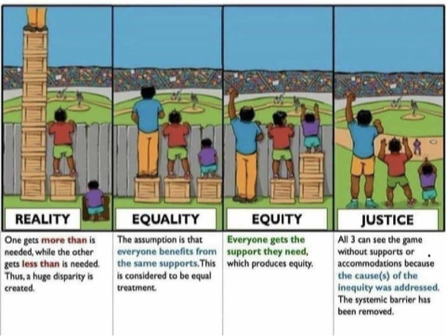
Conservative justice starts from a position that people deserve what they get. It is a merit-based form of justice, whereby what you deserve or don’t is based on what you have done. There is no recognition of how past social inequalities linger and shape intergenerational outcomes in this view, nor of how social norms ask certain groups to disproportionately do the unpaid work of care that limits their ability to engage with paid work. There is also no recognition of a public good. The foundational belief is people should be able to keep what they have earned and then pay at the point of use for those things they want. A belief that we should not have to pay for school meals, childcare, or education if we do not have children is an example of such thinking. This thinking fails to recognise that we all benefit from having well fed and educated children. There is a focus on equality, whereby everyone is treated the same way, regardless of the myriad differences that make us human. This is in stark contrast to equity, where people are provided with what they need to succeed. Everyone should not get the same because our needs are not the same.
While equity is an essential first step in achieving progressive justice, it is insufficient because it does not acknowledge that past injustices have effects that linger into the future and create barriers that require dismantling. Progressive justice is about improving social conditions or making a better world. Drawing on Rousseau, progressive justice also recognises that the social order (e.g., class structure, conventions on behaviours linked to gender) does not come from natural selection but instead is founded on social conventions that have given advantages to some and, therefore, work for those who benefit and disadvantages to others and as such do not work.
Progressive justice also depends on recognising that we only achieve the position and value we have because others recognise that value. If I refuse to acknowledge your position, I am also denying your position. A president only has authority if people grant them that authority. Where conservative justice fails is that it does not acknowledge this fact. Hegal argues that acknowledging this fact of recognition is (part of) what creates society. He contends that we only achieve our own autonomy through mutual recognition–I recognise you as someone who has the authority to say that I have status. The irony of freedom is that we cannot be free except in terms of our relations with others and through being in society.
Humans desire and need to receive and give recognition because it helps us to have a sense of ourselves. We commit acts of moral violence through misrecognition and denial, such as when we deny rights or refuse social inclusion. People who experience this moral injury experience indignity and are denied self-hood, which is the core experience of injustice. Recognition creates community.
So what does this mean for crisis?
To mitigate crisis, we must prevent it before it happens and eliminate vulnerabilities. This cannot occur through conservative justice that reifies individualism, sees difference as rooted in a pre-given (god given?) natural order, and starts from a position that people deserve what they get. Real human progress can only happen if we acknowledge the community’s central role. Among the stories of difficulty and hardship that resulted from Hurricane Helene, there also emerged quiet stories of care and community. People hauled water for those who could not do it themselves. Food was shared with those who were without. People opened their homes for those lacking shelter. These are not stories of conservative justice, but of progressive justice and illustrate that we all benefit from a society that breaks down barriers that limit the capabilities of people to thrive and succeed.
On Tuesday, 5 November, there is an election. The only way to achieve a better world is to evaluate those running for political parties on a justice basis. Even when choices are not perfect, a balance in favour of progressive justice is progress. Indeed, candidates that call for individualism, maintenance of hierarchies established in the past and their corresponding misrecognition can only lead us into more profound crises, which, without community, we will not survive.
Today’s news also included the key takeaways from the UK Budget. People have been talking about this for some time now and there will be more talk, no doubt. The doubters will be angry, regardless. But I contend that much of this doubt stems from a lack of understanding about the ethical underpinnings. The budget increases taxes by £40 billion. A big number even in national budget terms. Beyond understanding in household budget terms. But the importance is in the how not the what.
The minimum wage will increase for those over 21. This will increase tax takings because incomes will be higher for so many (and yes, businesses will say it cuts into their ability to survive and for some, it will, but for many, it will just mean the bonus to the big boss may not be so high. I’ve written about this elsewhere). It will also impact charitable organisations and social enterprises that deliver so many of our community services, which is worrying. One of the groups most vulnerable to food insecurity is young people. A decent wage is necessary for a healthy diet and wellbeing. A healthy workforce is also more productive.
Employer national insurance is increasing. This, again, is a benefit to society because National Insurance pays for health care. A healthy workforce is also more productive. Universal Health Care benefits us all and is a public good. You may not need it now, but in all likelihood, you will one day.
Capital gains tax will be more in line with income tax from employment. Many who pay themselves through dividends do not pay income tax, and they have been doing this to avoid paying taxes. Most people with lower incomes do not have the option to take dividend payments. This progressive tax increase asks those who are more advantaged to pay a bit more of their share.
The conservative party froze tax band thresholds for those who receive wages. These will rise at the rate of inflation from 2028. This is progressive as it acknowledges that it is more expensive to be poor compared to being rich.
Those who are sick and disabled will get an increase in benefits. Current rates create a bare life for many. This will go a little way toward increasing the opportunities for people who are sick and disabled to be able to thrive.
Carers’ allowance income thresholds will increase, and the unpaid work people do to care for others will save the public purse a lot of money. Pushing them into or keeping them in poverty only undermines their health. This is progressive.
The household support fund is to increase. This is generally good, as so many local authorities are using some of this money to build community interventions that increase resilience (for example, by funding interventions at rungs 2 and 3 of the food ladders. However, I am not convinced by the cash-first approach that has also been used because I do not see it as a human development approach, as I’ve elaborated here and here.
Fuel duty will be frozen at 5p.
The duty on draft beer will go down by 1.7%. It remains to be seen if this will extend to the customer or even the pub landlord. Let’s wait and see.
Tax on cigarettes, tobacco, and vaping will increase. From a public health perspective, this may be a good thing as it is thought to encourage people to cut back or not start. However, a large number of smokers get their tobacco from abroad, where they are much cheaper. People who go away bring them back for their smoking friends.
VAT will be charged on private school fees. One effect will be that these schools will become even more elite as those who can only just afford to send their children to these schools will no longer be able to do so. However, these children will still need to go to school, and this will push these children into state schools, which may not be a bad thing. The budget also has money to rebuild or replace schools that are not fit for purpose. This feels like a progressive policy in the round.
The budget for school breakfast clubs will be increased. I’m torn on this one. Breakfast clubs can be good and help a lot of children. I would rather see the funding go toward an uplift in the threshold for free or universal free school meals. However, if this latter were to happen, we would need a new mechanism for calculating the pupil premium.
Increased spending for those children with special education needs. This is progressive in that it can reduce the barriers that SEN impose on people’s life chances and their ability to thrive in later life.
HS2 between West London and Birmingham will go ahead. It is not my first choice for public spending, but I can see some benefits.
Tax on private jet travel will increase by about £450 per passenger. The hope is that this will reduce such air travel. This has positive environmental implications, and it is unlikely to impact those who struggle the most.
The soft drink levy will go up. Again, there are health implications. However, it pushes such beverages into luxury product territory.
Overall, this is a much more progressive budget than expected and that we have seen in a very long time. It is likely to impact those who can afford it much more than those who can least afford it.
The government has 5 missions: Kickstart economic growth, Take back our streets, Break down barriers to opportunity, build an NHS for the future, and Make Britain a green energy superpower. Food security is imbricated with all these pledges.
Economic growth means good jobs and good jobs need people who can do them. This means having healthy people and being healthy rests on being food secure.
If you are food insecure, you are also isolated. In communities where people are isolated, there is also greater fear of crime, disaffection and anti-social behaviour. If we are going to take back the streets, we need to make spaces for communities to grow within them.
We know that children learn better when they are nourished. Yet too many children live in families struggling to just eat, let alone provide the nourishment needed to build healthy bodies and minds. It isn’t right that in a country as wealthy as this, so many of our children do not have the best chance that this wealth offers.
Too much of NHS resources are taken up with treating diet-related illness and the issues linked to social isolation. People with healthy diets and strong social networks live better and independently for longer, even with underlying health conditions.
If we allocate farmland to producing green energy, we are not producing the food that sustains us all. We must ensure that we take a systems view so that our energy needs do not undermine our food security in the long term.
Food insecurity in the UK is at an astonishing rate. According to the FSA government statistics, in autumn 2022, 1 out of every 4 adults experienced low or very low food security at some point in the previous 12 months—meaning they were frequently cutting back on portions, skipping meals, or in some severe instances, skipping meals for whole days. Nearly half, 46%, of people with household earnings of less than £32K are food insecure. More than 1 in 3 adults, 36%, who have at least 1 child are food insecure- This vulnerability increases for those with 3 or more children. In areas in the most deprived quintile, two out of every five, 40% of adults are food insecure.
My research focuses on improving people’s ability to have the food they need to live their best lives and how places—the communities where people live—can foster health and well-being or create barriers that isolate and disable.
With this in mind, and building on the UN’s 4 pillars of food security and resilience theory, I have created a framework called food ladders to help structure how people and organisations (public, private, and third sector) can collaborate in local places to increase the resources that are needed to be food secure. (hand out materials).
The UN sees food security as more than just a financial issue. Food access is financial, but it is also linked to legal and structural barriers. Food security is also about availability—the food people need for a healthy and fulfilled life, which is available where they live without undue stigma, stress, and struggle. It is also concerned with utilisation—do people have resources, including money, knowledge, know-how, tools, and mental and physical states, to utilise the available food they can access? And fourth, is this all consistent and sustainable for the future?
When you are wealthy, you can have healthy meals delivered, but this is not an option for most of us all the time. We need other resources like having a shop we can walk to, an able body that lets us carry our food home, a home with a kitchen and tools that work, knowledge about what different foods are and how to cook them, and the head space to be able to do all that.
Health is negatively impacted when people are food insecure, leading to a downward spiral of deeper food insecurity. Repairing is much easier when people are not in crisis or have never been.
How we organise food support makes a big difference to who and how people use it and what they can get from itFood gets people in the door. When they come back, more support will be provided. So many of the organisations I have worked with talk about how this. Yet, we know that one of the most significant barriers is getting people the support they need, and there is a lot we still don’t know. But what I do know is that there is a big difference between a food club and a food bank or a social eating space and a soup kitchen, and this has to do with how values are expressed through the ways that food is made available.
The Food Ladders offer a three-rung approach to capitalise on these differences.
Catching for those who need immediate support, but we don’t want people to keep coming back to this rung. What we want is for people to move to rungs 2 and 3.
Capacity building enhances the assets and resources people and communities already have and contributes to those that they don’t
And finally, self-organising activity that increases sustainability and removes or redistributes vulnerability to make a fairer society.
One organisation (of many) I work with, TBBT, facilitates food clubs across 124 community locations, mainly in the north of England. We did a survey with members that resulted in more than 9k responses. We found that as a result of using the club, people reported
Increased fruit and veg uptake
Cooking more healthy food at home
They also get involved in food talk with club members and build friendships. The majority say they feel less alone and feel more involved in their communities. These friendships turn into mutual aid. During lockdown, people shared advice and checked in with each other through WhatsApp groups.
The majority had not used any food support before using the food club, but of those who had said they used a food bank, most said they used them less frequently or stopped using them altogether.
We know that when we have thriving communities, the fear of crime decreases. Food activities such as food clubs and social eating spaces support thriving communities. To take back our streets, we need to make space for people on those streets to intermingle and eat together.
Despite this and the increases in these activities, our communities are dominated by interventions that do not increase food security capability.
To facilitate food ladders, we need:
More resources and industry collaboration for community food programmes that don’t reinforce the status quo but instead build capabilities at rungs 2 and 3.
A national mandate and funding for local food strategies.
Investment in social development programmes to ensure that people have the capabilities to live a healthy life.
Adequate incomes that offer living wages and advancement opportunities, with a safety net for those who cannot access work.
Free school meals for all children in state schools would be great, but at a minimum, lifting the earnings threshold should be a priority.
A review of business rates such that those businesses that predominantly offer healthy foods are not disadvantaged because they have more risk compared to those who offer few healthy foods.
And finally, I offer a plea for better data with larger sample sizes. Without understanding, we cannot produce insights that lead to change.



 GeoFoodie
You must be logged in to post a comment.