“Mean Professor” and the context of rudeness

Mean Professor Tells Student to “get your sh*t together”

This story appeared a couple of years ago and soon after NPR did a musical version (http://tinyurl.com/cgwww3o). The blogger received hundreds of comments and likes. More recently it appeared on my facebook page, posted by another academic. The story, and the sentiment, still have currency. Indeed, the rudeness of students is often something discussed by university teachers (and I suspect other teachers as well). We talk strategy for getting students to be on time (and be quiet and turn off their cell phones). We lament a situation where we do not feel as empowered to say what we feel as this particular professor did. We wish we could be Professor Snape or Lord Sugar and cut the-one-who-must-be-silenced down to size. Continue reading

What is Cosmopolitanism?

I presented sections of this work at the University of Sheffield/National University of Singapore workshop: Decentring Knowledge (10-11 September 2012).  Other material is drawn from a lecture on Cosmopolitanism that I gave at Hong Kong University in 2012 to my students taking Geog3414: Cultures, Social Justice and Urban Space.  

What is Cosmopolitanism?

Although not a new term, the idea of cosmopolitanism has experienced a recent revival and has gained currency in theoretical debate.   Much of this revival comes from a concern with the persistence of conflicts based on preserving or expanding territorial Continue reading

Things to think about when getting dressed in the morning.

I’ve been thinking a lot about style lately.  This has been primarily in terms of clothing, but also in terms of lots of other things.  This thinking has arisen mostly because I am of an age when what worked before does not now necessarily work so well (and the fact that my secret desire has always been to be a designer of some sort).  Choosing what to wear is an everyday activity that can take a little or a lot of time; create a little or a lot of anxiety.   The effort around determining one’s personal style is played out certainly in front of the mirror in the morning, but also in the stores.  It is probably why people both love and hate to shop. Indeed, Louis Waxman, in a recent Thought Catalog offered the following quote from Ira Glass that captures this anxiety perfectly: Continue reading

Gendered income inequality and the precariousness of street trading

Image

Gender differences and the precariousness of street traiding

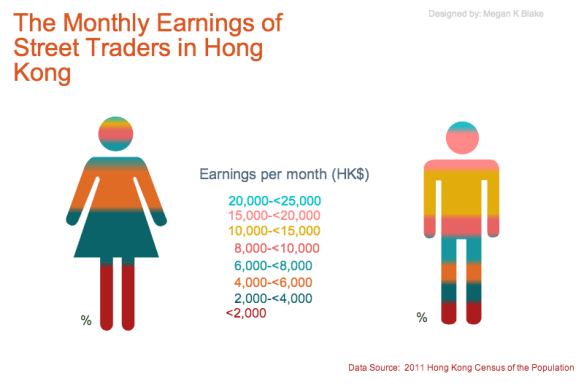
In the HK census there is an occupation category designated as street traders. The fact that there is a specific category tells us something about the state of being in Hong Kong. The census tells us that there are nearly 15.5 thousand steet traders in Hong Kong, but actually there are probably more, as a lot of the street trading is illegal and people may also do it on a part-time basis. What this info-graphic demonstrates, is that firstly street trading is a precarious business for everyone, but particularly for women.

The ratio of male street traders to female traders counted by the census is 3 to 2. The reasons for the income differential is unclear. It may be that women have locations that are less profitable. It may be that the goods that women street traders sell are less valuable so overall earnings are less. Some evidence from studies done in the 1970’s and 80’s indicate that street trading is often a family business and women work as family labour. We just don’t know as street trading is something that many at government level in Hong Kong wish would just go away. It clearly isn’t and as International Women’s day passes, it is also clear that there is further work to be done with regard to gender equity at all levels of society and all over the world.

red coversThe 2011 HK census has a new online feature where you can make your own tables. The website can be found here.

If you want to make your own infographic, you might try Pictochart, which is how I made this one.