Entering Shenzhen

Lo Wo MTR, at the border between Hong Kong and Shenzhen, China

Lo Wo MTR station at the border between Hong Kong and Shenzhen, China

This is the platform at Lo Wu, which is the end of the East Rail Line of Hong Kong’s MTR. Once you pay your fare you enter the border crossing to China. The first thing you must do to proceed with your journey is go through the HK SAR passport control. As an ID card holder of Hong Kong, I am able to progress through an automated gate at this point and enter the bridge that marks the space between Hong Kong and Mainland China. On the other side, I queue in the foreigner line to show my passport in order to complete the crossing.  Hundreds of thousands of people cross this border every day. It is a fascinating place. Continue reading
“Mean Professor” and the context of rudeness

Mean Professor Tells Student to “get your sh*t together”

This story appeared a couple of years ago and soon after NPR did a musical version (http://tinyurl.com/cgwww3o). The blogger received hundreds of comments and likes. More recently it appeared on my facebook page, posted by another academic. The story, and the sentiment, still have currency. Indeed, the rudeness of students is often something discussed by university teachers (and I suspect other teachers as well). We talk strategy for getting students to be on time (and be quiet and turn off their cell phones). We lament a situation where we do not feel as empowered to say what we feel as this particular professor did. We wish we could be Professor Snape or Lord Sugar and cut the-one-who-must-be-silenced down to size. Continue reading

Fortune Cookies, Char Siu Pork and Time Travel

You won’t find fortune cookies in Hong Kong, or in other parts of China for that matter. Apparently they are a very old Japanese invention. They became Chinese in the United States. I presume this probably occurred to some degree in the same way that Pakistani and Bangladeshi food in the UK became Indian–through a lack of understanding by the dominant culture of ethnic-national differences in groups.  Pakistani and Bangladeshi migrants found that, in general, the British could locate the Indian subcontinent, but not individual regions and groups, so these groups generalised their geography when identifying their foodways commercially.  Thus, to my mind, it is likely that in the gold-rush era, which saw large influxes of Asians into the western US, the (not so) subtleties that distinguish Japanese from Chinese were lost on the miners who were eating this food. After all the miners referred to these restaurants as Chow Chows and Chinkies. Hardly sensitive or subtle. Continue reading

The Colour of Everyday Life

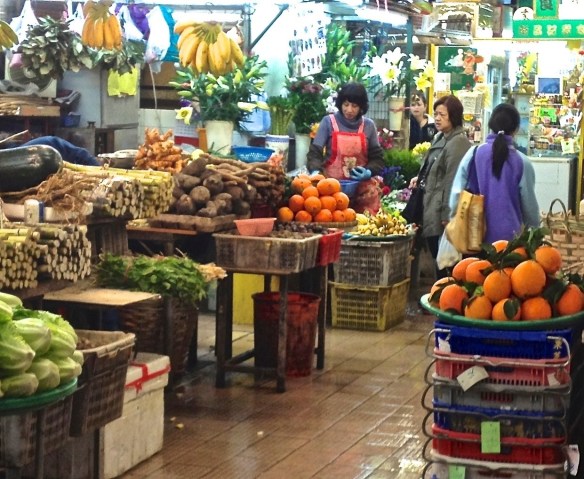
20130406-071320.jpgI’ve posted about the wet markets in Hong Kong before. These urban spaces can be colourful and lively, such as the market in Shatin pictured above, or they can be dead spaces lacking colour. Certainly from the outside, the facades that house the FEHD and ex-FEHD markets do not reveal the potential for the liveliness contained within. Continue reading