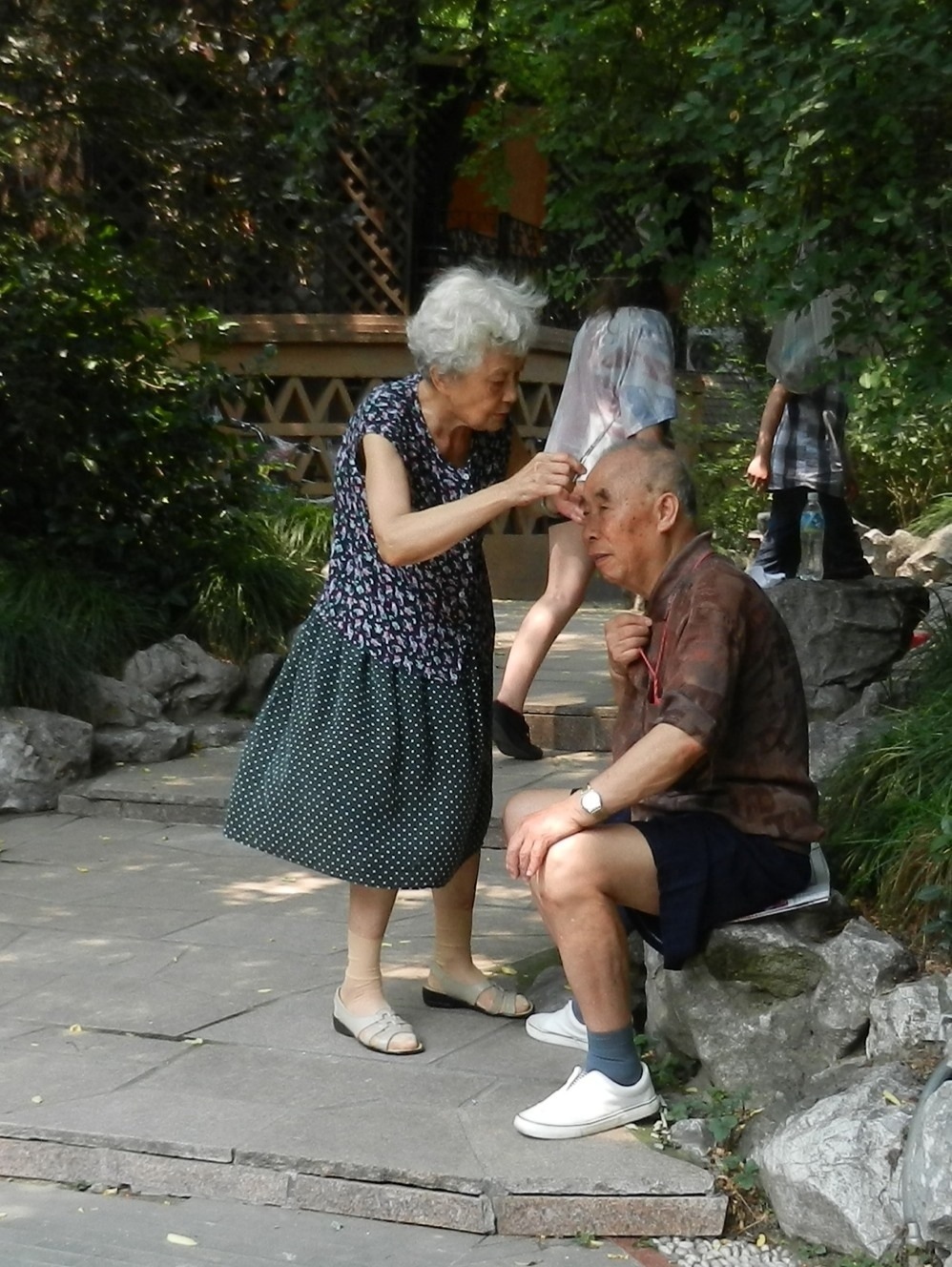
On the last family holiday I took with my husband and children we went to Shanghai and the Yellow Mountains. It was a lovely trip involving cities, historical villages and what purported to be nature walks, but which felt much more like an amusement park given the fact that there were so many people! Despite this, it was an important trip for us, as we experienced a side of China beyond what you read in the news or what is often part of preconception. Continue reading
Monthly Archives: June 2013
Seeing below
Hong Kong is a city of views. Upon arriving in Hong Kong one is assaulted with the image of the famous skyline. This commanding perspective offers a view of the top both literally and figuratively, if we also consider that much of that skyline represents the global circulation of things and money. Populated with 294 buildings over 150m tall (35-40 floors), and 2,354 buildings over 100m tall (New York only has 794), the city handily wins as being the place with the most opportunity to look down from above. But what do you see when you look down? Continue reading
Bloom’s Taxonomy and Collective Understanding
Bloom’s taxonomy is an heuristic designed to help educators develop teaching methods that will move student’s learning beyond rote memorisation. Learning beyond memorising is sometimes considered higher order or deeper learning. Since the taxonomy was developed in the mid 1950’s it has informed education policy across the globe and has inspired countless innovations in teaching and learning including Research-led Teaching and Learning, Service Learning, and more recently Knowledge Building approaches. It has also been used to help educators develop learning outcomes for Objective Based Teaching and Learning (OBTL) that are then assessed via Criterion Referenced Assessment (CRA). In this post I discuss how I sought to achieve higher order learning through a student web page project in Hong Kong and what that process revealed to me about Bloom’s taxonomy. Continue reading
Curves that circle round

Incense burning in a temple, Hong Kong
The smell of incense always brings me up short and evokes a Proustian moment that causes me pause. The smell of incense will always be Hong Kong in my mind. The sweet, heavy odour is encountered in accidental moments throughout the city as there are large and small temples, some so small they are just depressions outside a door, all over the city. Incense gives a home to the ghosts of elders, freeing up domestic space for good fortune. It also gives thanks for gifts bestowed by gods and is offered in anticipation of future benefit. As such it’s circular form is also a mechanism through which time can curve back upon itself.


You must be logged in to post a comment.