
Food Ladders are made up of three rungs and connecting rails.
The Food Ladders model uses ‘rungs’ to show how different activities help people achieve food security. These rungs focus on practices (like shopping at a farmers market) instead of organisations (like a food bank). No rung is more important than any other – a ladder needs all its rungs to work – but each rung provides different types of activity. It also needs rails.
Rails support and stabilise the ladder, ensuring it remains upright and secure. These are the activities that connect each of the runs together, such as coordinating, funding, facilitating, communicating, organising, and so forth. The ladder is just a pile of planks without the rungs.
The model acknowledges that people face challenges in getting the food they need. This is where capabilities come in. People need resources, skills, and freedom to participate in food-related activities.
Activities also take place across multiple ‘domains’. These are areas of life that utilise certain sets of skills to engage with activities in those domains. Domains commonly engaged within community food activities include food (e.g., cooking, growing, classifying), social, economic, and health (including well-being and physical health). Other domains may be or become relevant in specific contexts or to achieve a specific vision, such as the environment.
Activities may provide interventions that operate in just one domain on one run or may contribute to a range of domains on the same or different rungs.
Rung 1: Catching
Catching activities are done for people. They provide the resources needed to meet people’s basic needs and functions in times of crisis. Activities are often organised by charitable or public sector organisations, and decision-making is held by those offering the service with little or no input from those who are beneficiaries. There is a clear divide between those who receive the support and those who deliver it.
This rung is important because life can be overwhelming when people are in crisis. Catching activity can provide a pause and a place to regather.
Case study: Food Banks and Cash First
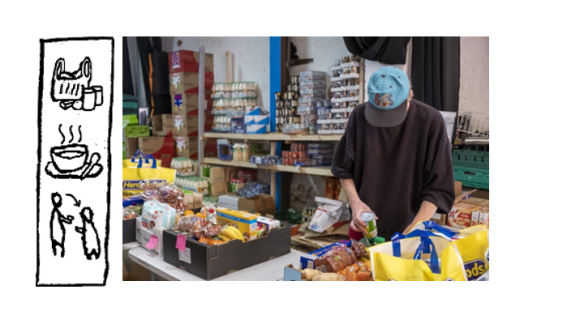
Food banks, known as food pantries in the United States, are the most frequently referenced form of emergency food provision. At minimum, and most frequently, they provide recipients with parcels of dried and tinned (shelf-stable) food; some also offer fresh foods such as fruits and vegetables. Accessing food in such a way will address basic needs, but only on a short-term basis – once the parcel is finished, people find their circumstances unchanged.
Some organisations are beginning to experiment with giving people cash payments or supermarket gift cards instead of food parcels. This can give recipients more choice over what they eat, but again, this is a short-term intervention with limited effect on people’s security once the cash is spent. Indeed, cash payments can often reinforce existing food habits (read more here). Catching activities tend to be individualised, with few opportunities for connecting food recipients with others. However, emergency food providers often signpost recipients to other local activities that can offer longer-term support, such as debt advice services and other nearby capacity-building activities.
Rung 2: Capacity Building
Capacity-building activities are done with people. They aim to increase the availability of existing opportunities, skills, resources, or knowledge or introduce new ones. Whilst still primarily organised by VCS or public sector organisations, activities often integrate participants’ interests, desires, and feedback. The divide between the service provider and the beneficiary is quite blurred, which is a crucial distinction between Rung 1 and Rung 2 activities. Volunteers who eat the food or benefit from the social interactions may also be involved in the food’s cooking, growing or sourcing. Community members are frequently involved in decisions about additional services that may be offered.
This rung is significant because the gap between recovering (rung 1) and having the capability to be food secure and able to contribute to food system change (rung 3) requires new skills, space to think, and improved social networks.
Example case study: Open Kitchen Social Club

Social eating activities such as those organised by Open Kitchen Social Club in Sheffield (England) offer opportunities for participants to build capacity over several domains. Regular community meals catered to a diverse audience of asylum seekers, refugees, and British natives create accessible space for the sharing of food and culture. Diners are encouraged to participate in running the service, sharing recipes, clearing tables, washing up, and cooking in the kitchen. As with meals organised by NGCFI, community-led activities naturally occur alongside, such as arts and crafts sessions or game playing. Open Kitchen also provides opportunities for participation in commercial activities, as they subsidise their community meals with a private catering service. This supports community activities financially whilst allowing community members to develop skills and gain work experience. Overall, the activities offered give people access to nutritious food in a sociable, supportive setting and open opportunities for purposeful activity and skill development. This activity builds capability in the food, social, and health domains.
Further examples include:
- Social supermarkets and food hubs like those offered by Community Shop, EggCup, and St Giles Trust and food clubs such as those provided by The Bread and Butter Thing or through the Feeding Britain network.
- Community gardening such as Rhubarb Farm
- Cookery skills such as Men’s Pie Club, Best Food Forward or Bags of Taste
- Financial support such as Food Savers
- Nutritional menu sourcing on a budget such as through Meali
Please note that while organisations are listed according to their primary activity, each of these organisations offers activities in ways that increase capabilities across more than one domain.
Rung 3: Self-Organising
Self-organised activities are done by people. They are primarily initiated or run by local community members according to their own interests and for the primary benefit of the community itself. However, they may still be supported by third-party organisations. These groups often use the language of food citizenship in their activities. This rung adopts, wholeheartedly, as Asset Based Community Development (ABCD) approach.
Rung 3 is important because this is where community-driven change happens. This is the space where the root causes of vulnerability to food insecurity are challenged.
Case study: Food Squad
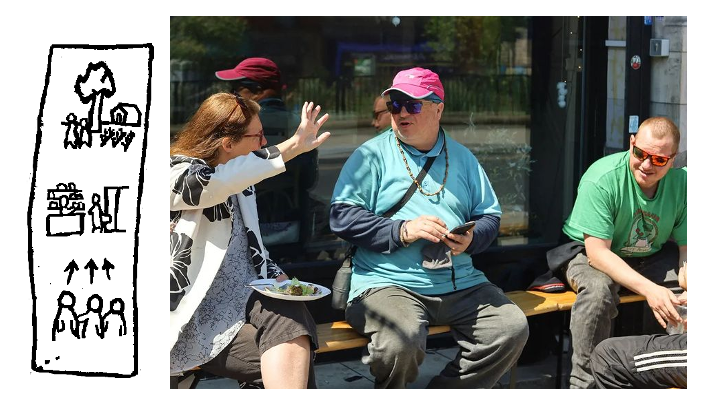
Food Squad organise weekly communal meals in Sheffield city centre, cooked by volunteers and served on a suggested donation basis. The group formed in response to the closure of Foodhall, a radical community centre and public dining space which hosted a range of capacity-building activities. Faced with the loss of a space through which they accessed food and met new people, several regular Foodhall visitors decided to continue the project’s activities by self-organising their own provision. Without their own premises, the group use strong social networks (in part developed through their time at Foodhall) to organise pop-up community events alongside their weekly meals, with music nights, creative workshops, and haircutting sessions raising funds and supplementing their core food activity. Many of the activities organised by Food Squad can be seen to sit more on rung 2 than 3. However, the group’s emergence and organisation is in its own right a useful example of how engagement with capacity-building activities such as those offered at Foodhall can empower communities to self-organise, meeting their own needs and interests.
Case study: Unicorn Grocery
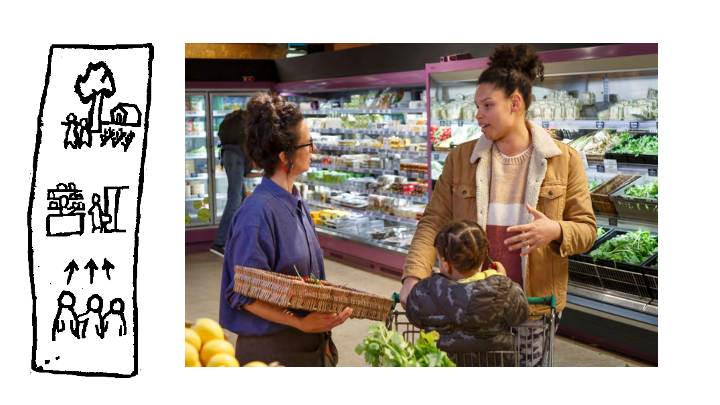
Unicorn Grocery is a workers-cooperative greengrocer based in Chorlton, Manchester, founded to offer an alternative to mainstream supermarket provision. The grocery stocks fresh fruit and vegetables, household essentials, baked goods and food to-go. Food is sourced according to clearly defined values, prioritising affordable, local, seasonal, low-processed, and sustainable products where possible. As a worker-owned cooperative, Unicorn is run democratically, with workers shaping the running of the business and the conditions of their own work. Wages are fair and equitable. Alongside the day-to-day business, the grocery also supports several community outreach activities: offering local groups donations of produce, funding educational programmes for local schools, and supporting the development of other cooperative initiatives through a solidarity fund and operational guides. The grocery also supports regional and small producers, buying straight from growers and manufacturers to ensure a fair price whilst keeping produce affordable for customers. Organic fresh produce is often cheaper at Unicorn than non-organic produce from mainstream supermarkets.
Case study: Govan Food For All
Rails
The rails provide the structure that keeps the rungs in order and stable. They connect all the rung activities together, whilst also helping secure the resources and assets that enable those working on individual rungs to keep going. A key rail actor is local food partnerships, which keep the focus on the vision, drive forward strategies and action plans, and coordinate working groups. The Sustainable Food Places is a national-level organisation that has created a network of local food partnerships and is led by the Soil Association, Food Matters, Sustain, Food Sense Wales, Nourish NI, and Nourish Scotland. It aligns well with the Food Ladders approach because it recognises that a sustainable and equitable food system requires collaborative action between local-scale policy makers, business, and civil society, as well as strong national policy.
Case study: Lancaster District Food Justice Partnership
The Landcaster District Food Justice Partnership has adopted the Food Ladders as their approach toward ensuring that they make sure their safety net is robust and complete to catch people falling into crisis, that they stimulate interest and build on people’s abilities, providing a framework of support to allow people to build confidence and capacity, and and have an empowered community that independently and collectively develops new food projects. The food partnership has mapped thier serviews and community organisations to identify what support is available and where there may be gaps and deserts at each level.
The partnership coordinates different activities on the rungs to then fill those gaps. The partnership is made up of representatives from the local farming community, food businesses, the public sector, Lancaster City Council, NGOs, community food groups and local academic institutions. The partnership of people from across North Lancashire’s food system are working together to create a thriving local food system that is healthy, resilient and fair.
They do this by connecting initiatives and catalysing action across the food system, supporting the development of a collaborative cross-sector food partnership that oversees the cultivation and delivery of their food strategy. They achieve this work through working groups that take forward elements of the food strategy. The strategy is aligned with the parish council’s food strategies. Through this work, it has created a support network that allows people quick and easily accessible food in times of crisis. The aim is to move people out of crisis quickly toward the many other community-led initiatives where food is shared and further capability is gained.
Their strategy development process involved bottom-up collaboration and adopted co-design principles to create a positive vision for the future. This involved workshops and focus groups with a mixed group of local citizens, including online events. Over 250 participants engaged the the process including farmers, community growers, landworkers, local citizens, the Lancaster District People’s Jury on Climate Change, academics, business owners, activists, campaigner, sector professions, schools, health workers councillors, food bank and food club volunteers, religious organisations, and community groups.
Case study: Food For All Group
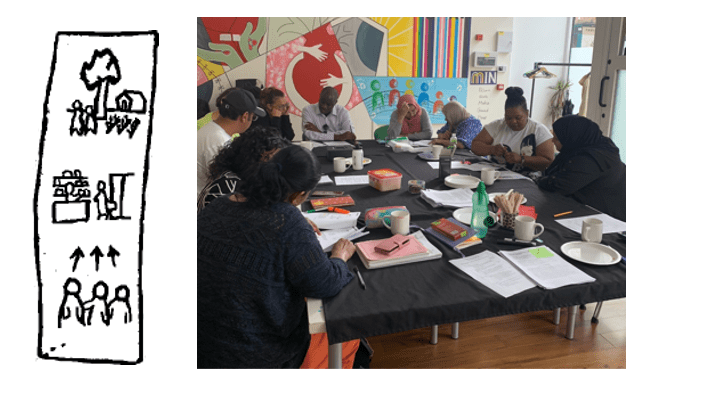
The Food For All Group is a group of people with experience of the asylum system who meet in Glasgow to organise around food-based issues. Hosted by a local community organisation, Govan Community Project (GCP), and co-facilitated by food policy campaigners Nourish, the group has developed numerous projects and campaigns centred around their own experiences of accessing food as asylum seekers. Led by their own interests and concerns, the group has produced resources to help community food providers better understand the needs of asylum seekers, for instance, developing guides to making multiculturally valued foods more accessible. The group also develops and runs workshops for those working in community and charitable food settings, creating a space where they can share their own expertise on their own terms. Though supported by GCP and Nourish, the group is a valuable example of peer learning and support, creating opportunities for meaningful change around issues personal to the group’s participants.
Examples of guides Food for All has produced include: A Beginner’s Guide to the Asylum Process, Everyday Challenges of the Charity System (session plan), Culturally Valued Food, and Religious Dietary Requirements.
 GeoFoodie
You must be logged in to post a comment.