by Megan Blake blogging mostly about how to build better foodscapes
Food Ladders Toolkit – Organising across the council
“When you come into our Council or local authority, there’s a number of teams just within public health, then there’s other teams that work with different things, then there’s a political organisation, the umbrella of it all as well, and … it’s how and where do you lead such a ladder when those bits are being managed by other people?”
Public Health Practioner, Bradford Council
Sometimes, it is unclear where responsibility for food should sit in local authorities. Food touches many policy areas, but rather than being tackled collaboratively, some councils take a siloed approach. In such cases, different council teams engage with food in the narrow ways that appear most relevant to their focus, e.g. Public Health might look at nutrition, Environmental teams might look at food waste and disposal, and Planning might look at regulating the placement of takeaways or allotments. This can lead to a doubling up of work in some areas where teams’ agendas overlap and, simultaneously, gaps where it is unclear whose responsibility a specific area is. This can also lead to internal and external confusion about who is the right person to speak to about different food issues.
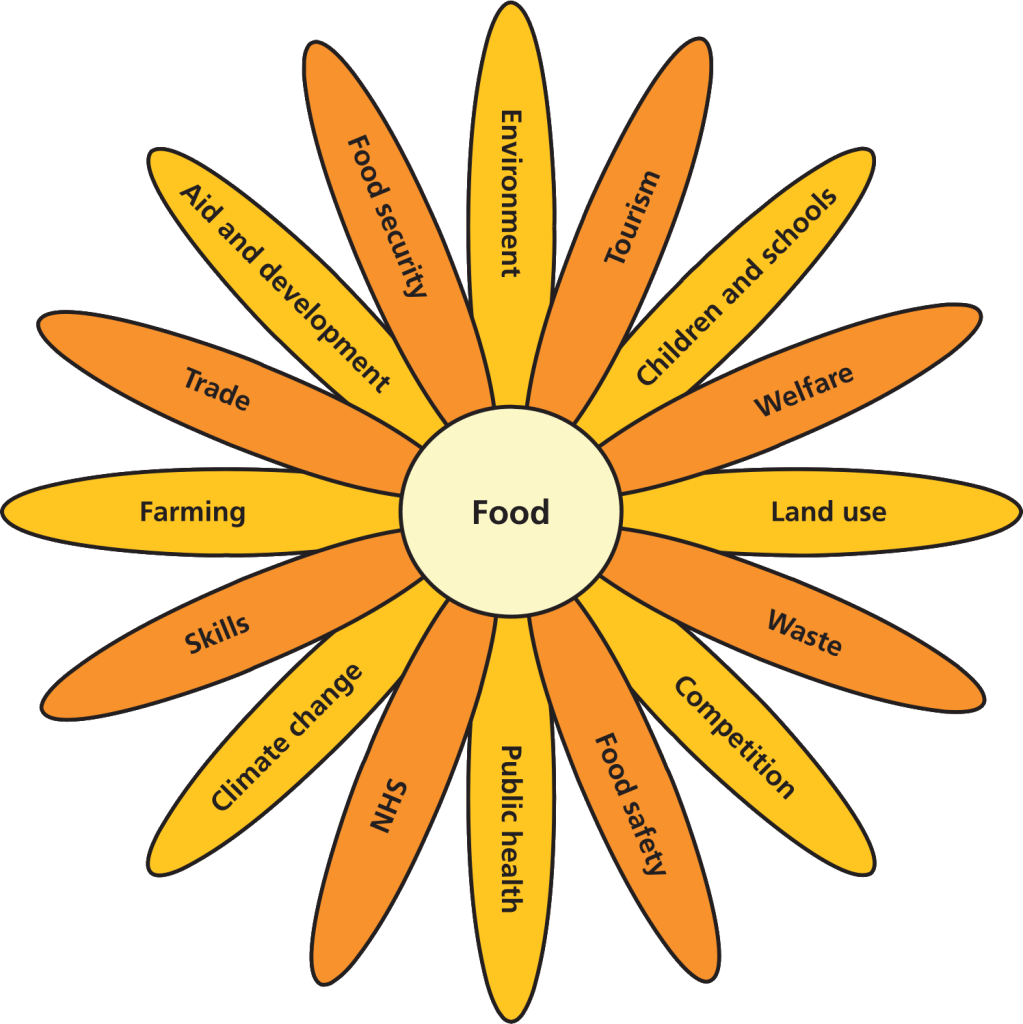
Food is vital for everyone, and the food system is part of many policy areas as illustrated by the <a href=”http://Food Policy Flower. Food insecurity may initially appear to be a concern for Public Health or Benefits teams. Still, as we know from the Food Ladders model, creating food-secure, resilient communities will require input from various areas. As such, a systemic approach must be taken, recognising that teams across the council have a shared responsibility for food. This responsibility is best taken on collaboratively, with teams sharing information, resources, and ideas across the council to create a food system that works for all.
Creating a Cross-Council Approach to Food
Several councils we spoke to have developed collaborative ways to ensure that food is a cross-council issue. One effective method is creating an intra-council interest group around food.
Case Study: Leeds City Council
A food strategy can only be successful if it has that breadth of policy areas and you don’t see your food and health policy, you don’t see a food and economy policy, you see a food strategy, and it’s touching on all those things.
-Health Improvement Specialist, Leeds City Council.
Following receipt of a Deputation in 2014 calling on the council ‘to initiate the development of a new Food Strategy’, the Public Health team in Leeds City Council were tasked with collecting information from all teams in the council whose work related to food. This led to creating a formal group within the council with representatives from all departments with food as part of their remit.
Meeting twice a year, a group of ~15 representatives from each directorate of the council meet to share good practices and information. The meetings are chaired by a rotation of three chief officers who ‘have food on their radar’ because their teams are named pillars of the city’s Food Strategy (Health, Financial Inclusion, and Economy, Sustainability and Resilience). Meetings follow set agendas, usually including a presentation item on particular news or progress of a project in the city, updates from each team, and discussion of any ongoing or upcoming campaigns. Once a year, a council-funded city food partnership representative attends the group meeting, updating them on the partnership’s progress and making requests to the council around ‘challenges that they couldn’t progress without Council support’. Outside meetings, the group keeps an email list of members to organise and facilitate communication. New starters are informed of the council’s food strategy and the meeting and then invited to join when it is relevant to their roles.
The group allows different teams to share information and consolidate available resources and capacity. For example, funding for the independent city food partnership was pooled across three teams rather than just one, reducing strain on any team’s budget and affirming food’s importance to multiple departments. The group’s success depends on participation from all relevant departments, which can be difficult to guarantee – the group requires buy-in from senior team members and a willingness to engage across departments.
Case Study: Nottinghamshire County Council
Get that strategic buy-in. Food has to […] have those strategic levers. So for us it’s been embedded in a whole programme of work that looks at the social determinants or the building blocks of health […] it’s not looking at food in a silo.
– Public Health Commissioning Manager, Nottinghamshire City Council
The creation of a Nottinghamshire Food Charter in 2022 demonstrated how food served the agendas of different council teams and gave a policy mandate for their input. An informal, voluntary interest group has also been created alongside this formal collaboration. Meeting monthly during lunch breaks, the Environment Group discusses issues related to climate, environment, and sustainability (of which sustainable food has been a central theme).
Originating through a desire for discussion and peer support around environmental work (and anxiety), the group functions as an informal space to create and strengthen interpersonal relationships across departments and teams. Meetings happen online to enable easy access from hybrid workers, with discussions on set topics and occasional guest speakers. Alongside monthly meetings, the group organises in-person social events and activities outside of work, including film screenings and tree planting. The group communicates outside of meetings and events through a dedicated Microsoft Teams channel, allowing members to stay in touch with each other and share information.
The group provides members with ways of connecting and influencing others and opportunities to learn who else is working on similar areas, providing a space for reflection on members’ work and identifying areas for change. Having acknowledged that ‘silo working’ can take over when teams are over capacity and unconnected, the group provides a positive and supportive space for workers to take a step back, reflect on their work, and deepen relationships with others from across the council. The interest group enables departments to connect even with limited political will (or council resources) to formalise relationships.
Tool 1: Key Organising Recommendations:
Be specific when talking about ‘the Council’ both internally and to external partners – name specific teams or workers responsible for different policy areas.
Formal cross-council groups can improve coordination and communication, and leverage resources across the organisation for food strategies.
Informal interest groups can provide space outside work for peer support, reflection, and deepening relationships between people from disparate teams.
Collective buy-in can be developed internally through council-wide policies such as an area-wide food plan or charter.

 GeoFoodie
You must be logged in to post a comment.