
Building a network is key to building food ladders. Food Ladders takes an Asset Based Community Development Approach that starts from a set of principles that everyone has gifts and that relationships build community. This means that all stakeholders must be part of the process. This includes everyone from those who eat the food to large-scale organisations, sometimes called Anchor organisations.
A key component of ABCD is that local communities invite anchor organisations to join them in partnership to create solutions, rather than have solutions imposed by those organisations. While in principle, this should be what happens, in reality, people may not be ready to self-organise in this way because this is rung 3 activity on the food ladders. To get to rung 3, larger organisations, such as the council or food networks, may need to be asked to step in to help build communities and provide training and opportunities that create the capabilities people need to be able to self-organise.
But, this does not mean that local people should be ignored initially. Bringing locally based organisations to the table to shape a vision that includes this capability enhancement will help them understand their role in building Food Ladders. While the Food ladders mapping activity tool will help you know who these organisations are and what their activity contributes, this is not enough.
You may also want to read this article about the process that ShefFood took in the development of a strategy and action plan that sits alongside the council’s plan.
This section of the toolkit is organised into three steps with tools associated to each.
Step 1. Identify your potential network
A complete network includes all who have a stake in creating a local food system that supports everyone. A stakeholder analysis will help you broaden your network to consider the different stakeholder groups and where additional work may be needed to bring them into the collaboration. Understanding who the stakeholders are and how they will likely engage with the process provides insight into how to approach different groups. It will also help reveal where certain groups are missing and where some voices may become dominant.
Tool 1: Stakeholder mapping and engagement
Step 2: Hosting
Once you have identified your different groups of stakeholders and decided the level of depth you will use to engage with them you will want to engage them in conversations about what they think about thier food system, how they engage with it, what they want from it. This involves careful thought and consideration. You may need to have a couple of sessions with different configurations. It may be that you hold sessions with different types of groups to start talking about what you are doing and see what they would like. You may then want to limit representation from each group in other meetings to ensure that voices and interests are not drowned out. Some types of participants can be very vocal, while others will be quieter.
It can also be intimidating for community members to attend formal settings. Using familiar locations that are convenient to these partners will also demonstrate your willingness to accommodate their needs, desires, and ambitions.
This video from the Art of Hosting, sets out 4 principles that should be followed to get the most out of these conversations.
Art of Hosting also has a useful list of methods for hosting conversations. These methods can also be used in the visioning work that you do later.
Tool 2: Methods for hosting conversations that matter
Tool 3: Articles to inform how you go about your conversations
Step 3: Asset Mapping
Once you have identified your network and recruited those essential to the project and its success, the next stage is mapping the assets and resources available in the community and its networks as this is how you bring resources and assets to your effort. Assets are things, people, knowledge, or social connections that can be mobilised toward achieving community goals. They do not diminish in their use; in many cases, they increase through use. Resources are things like money or non-renewable elements; once mobilised, they cannot be re-used (e.g., if you spend money, it is gone, or if you sell a building to a developer, it can no longer be used as a community centre). While the graphic below focuses on health, the same principles apply for creating food security assets.
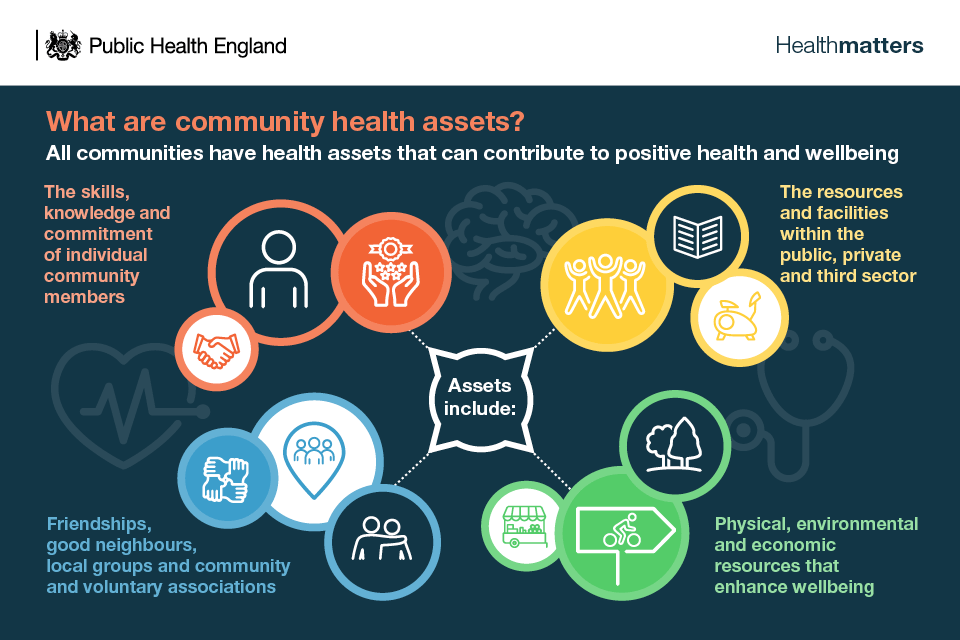
Tool 4: Asset mapping guide from Nurture Development. This guide describes the process of asset mapping from an ABCD perspective.
Tool 5: Community mapping guide developed by Preston City Council. This guide provides more detail about what to include as well as how to go about it, and there are case studies. It also takes an ABCD approach.
Depending on the group, you may find creative methods such as storytelling (as advocated by Nurture Development), using drawing and other artistic methods to identify the assets and resources available in a community can also be quite useful.
Tool 6: Participatory Policymaking using Serious Games. While this tool, developed for Wellcome Open Research, provides guidance for participatory policymaking, it can be repurposed for community asset mapping.
 GeoFoodie
You must be logged in to post a comment.